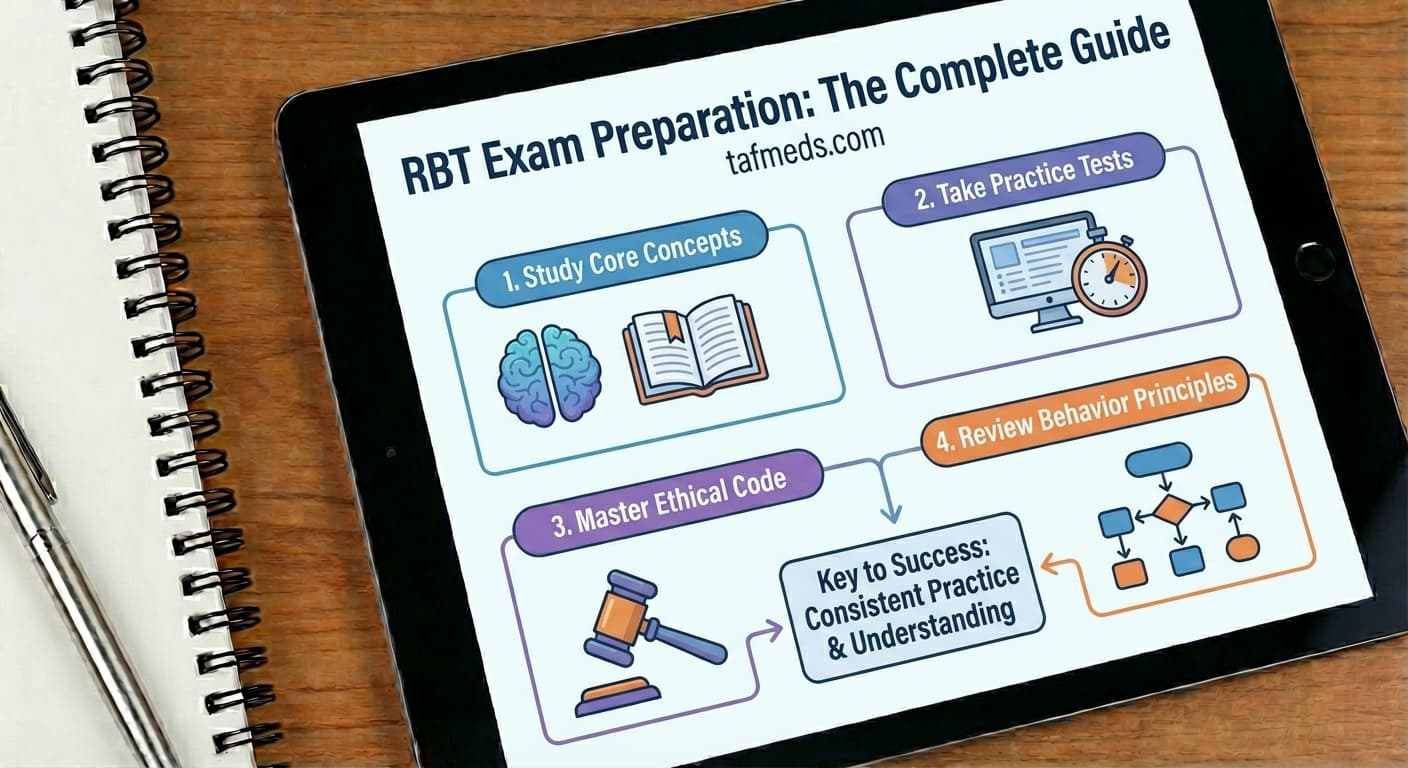
The Registered Behavior Technician (RBT) certification is often the first step into the world of Applied Behavior Analysis. Whether you're launching a new career, supporting a family member with autism, or building toward becoming a BCBA, passing the RBT exam opens important doors.
The good news? The RBT exam is very passable with the right preparation. The challenge? Most study methods leave candidates feeling uncertain on test day. You might recognize concepts, but under the pressure of a timed exam, that recognition doesn't always translate into correct answers.
This guide will show you how to prepare differently—using fluency-based methods that build automatic, confident responding. You won't just *know* the material; you'll be *fluent* with it.
Understanding the RBT Exam
Before diving into study strategies, let's understand what you're preparing for.
Exam Structure
| Component | Details |
|---|---|
| Number of Questions | 85 total (75 scored, 10 unscored pilot questions) |
| Time Limit | 90 minutes |
| Format | Computer-based, multiple choice |
| Passing Score | Approximately 68% (this varies slightly by exam form) |
| Cost | $50 USD |
| Retake Policy | Must wait 7 days; maximum 8 attempts per year |
The RBT Task List and Test Content Outline
The exam is based on the RBT Task List (3rd Edition) and the official Test Content Outline published by the BACB, effective 2026. Before you begin studying, download both documents from the BACB Test Content Outlines page. These documents are your roadmap—every exam question ties directly to these content areas.
The Test Content Outline organizes the exam into six main areas:
| Section | Weight | Topics |
|---|---|---|
| A. Data Collection and Graphing | 17% | Continuous & discontinuous measurement, graphing, data trends |
| B. Behavior Assessment | 11% | Preference assessments, skill assessments, functional assessment |
| C. Behavior Acquisition | 25% | Reinforcement, discrete trials, naturalistic teaching, prompting, chaining |
| D. Behavior Reduction | 19% | Functions of behavior, antecedent interventions, differential reinforcement, extinction |
| E. Documentation and Reporting | 13% | Communication with supervisors, documenting variables, session notes |
| F. Ethics | 15% | Core principles, competence, supervision, confidentiality, professional skills |
Why Traditional Study Methods Fall Short
Let's look at how most RBT candidates prepare—and why it often leads to uncertainty on exam day.
The Typical Approach
- Read through the RBT Task List
- Watch training videos from the 40-hour program
- Make or buy flashcards
- Review flashcards slowly until terms "feel" familiar
- Take a few practice tests
- Hope for the best on exam day
This approach builds recognition—you can identify correct answers when you see them alongside clearly wrong alternatives. But the RBT exam doesn't always give you clearly wrong alternatives. Often, you'll see four options that all seem plausible if you're not fluent with the material.
The Real Challenge
Consider this example question:
A client engages in hand-flapping when presented with difficult tasks. The behavior has been determined to be automatically maintained. Which of the following is the MOST appropriate initial intervention?
A) Implement extinction by blocking hand movements
B) Provide a functionally equivalent replacement behavior
C) Use noncontingent reinforcement with matched stimulation
D) Implement differential reinforcement of other behavior
All four options are real ABA interventions. Without fluent knowledge of automatic reinforcement and function-based interventions, you might spend two minutes analyzing this question—time you don't have.
The fluent candidate recognizes immediately that automatic behaviors often require matched stimulation or sensory alternatives, making C the best answer. They select it in 30 seconds and move on.
The Fluency-Based Approach to RBT Prep
Fluency-based learning doesn't just help you remember terms—it helps you think in ABA. Here's how to apply it to your RBT preparation.
Building Your Foundation: Core Terminology
Start by building fluent recall of the essential terms in each Task List section. You should be able to define and identify examples of each term within seconds, not minutes.
Section A - Data Collection and Graphing (aim: 10-13 correct/min typed)
Key terms to master:
- Continuous measurement (frequency, duration, latency, IRT)
- Discontinuous measurement (partial interval, whole interval, momentary time sampling)
- Permanent product recording
- Calculating rate, percentage, and mean duration
- Identifying trends in graphed data
- Procedural fidelity and data reliability
Section B - Behavior Assessment (aim: 8-10 correct/min typed)
Key terms to master:
- Preference assessments (multiple stimulus, paired stimulus, free operant)
- Skill assessments (curriculum-based, developmental, social skills)
- Functional assessment procedures (descriptive assessment, functional analysis)
- Operational definitions
Section C - Behavior Acquisition (aim: 12-15 correct/min typed)
Key terms to master:
- Positive and negative reinforcement procedures
- Conditioned reinforcers and token economies
- Discrete trial training components (SD, response, consequence)
- Naturalistic teaching procedures (incidental teaching, NET)
- Prompting and fading procedures (errorless, least-to-most, time delay)
- Discrimination training
- Chaining (forward, backward, total task)
- Shaping procedures
- Generalization and maintenance
Section D - Behavior Reduction (aim: 10-13 correct/min typed)
Key terms to master:
- Functions of behavior (attention, escape, tangible, automatic)
- Antecedent interventions (NCR, high-probability sequences, demand fading)
- Differential reinforcement (DRA, DRI, DRO, DRL, FCT)
- Extinction procedures and secondary effects
- Punishment procedures (positive/negative)
- Crisis/emergency procedures
Section E - Documentation and Reporting (aim: 6-8 correct/min typed)
Key terms to master:
- Communicating with supervisors and intervention team
- Seeking clinical direction appropriately
- Documenting variables affecting client progress
- Objective session documentation
Section F - Ethics (aim: 12-14 correct/min typed)
Key terms to master:
- Core ethical principles (benefit others, compassion, dignity, integrity)
- Competence and scope of practice
- Supervision requirements and practices
- Confidentiality and public statements
- Multiple relationships and gift guidelines
- Cultural humility and responsiveness
- Interpersonal and professional skills
The Daily Practice Protocol
Here's how to structure your daily study sessions using SAFMEDS methodology:
Study Session Structure (60-90 minutes):
- WARM-UP (5 minutes)
- Review previous session's error cards
- Quick mental review of content areas
- TIMED PRACTICE (30-40 minutes)
- Complete 4-6 one-minute timings per content area
- Record correct and incorrect counts
- Shuffle cards between timings
- ERROR ANALYSIS (10-15 minutes)
- Identify patterns in errors
- Create new cards for confused concepts
- Review related content
- PRACTICE QUESTIONS (20-30 minutes)
- Complete 15-25 practice questions
- Focus on current content area
- Analyze incorrect answers
- PROGRESS REVIEW (5 minutes)
- Chart your fluency data
- Set goals for next session
A 4-Week Study Plan for the RBT Exam
Most candidates need 4-6 weeks of focused preparation. Here's a week-by-week breakdown:
Week 1: Foundation Building
Focus: Sections A (Data Collection and Graphing) and B (Behavior Assessment)
| Day | Morning (30 min) | Afternoon (30 min) | Evening (30 min) |
|---|---|---|---|
| 1 | Review measurement terms | Create measurement cards | First timings |
| 2 | Timings + error review | Assessment content review | Create assessment cards |
| 3 | Combined timings (A+B) | Practice questions (20) | Error analysis |
| 4 | Timings focus on errors | Video review of concepts | Additional practice |
| 5 | All timings | 25 practice questions | Progress charting |
| 6-7 | Light review | Rest | Rest |
Week 1 Goals:
- Data Collection fluency: 25+ correct per minute
- Behavior Assessment fluency: 20+ correct per minute
- Practice question accuracy: 70%+
Week 2: Behavior Acquisition Deep Dive
Focus: Section C (Behavior Acquisition) - this is the largest technical section at 25%
| Day | Morning | Afternoon | Evening |
|---|---|---|---|
| 1 | DTT and prompting cards | Timings + review | Practice questions |
| 2 | Chaining and shaping cards | Combined timings | Video review |
| 3 | All Section C timings | Error card review | 25 questions |
| 4 | Sections A-C timings | New concept cards | Practice test (50 q) |
| 5 | Focus on weak areas | Cumulative review | Progress charting |
| 6-7 | Light review | Rest | Rest |
Week 2 Goals:
- Behavior Acquisition fluency: 30+ correct per minute
- Cumulative fluency (A-C): 25+ per minute average
- Practice question accuracy: 75%+
Week 3: Behavior Reduction and Documentation
Focus: Sections D (Behavior Reduction) and E (Documentation and Reporting)
| Day | Morning | Afternoon | Evening |
|---|---|---|---|
| 1 | Function-based content | Create Section D cards | First timings |
| 2 | Section D timings | Documentation review | Create Section E cards |
| 3 | Sections D+E timings | Cumulative A-E timings | Practice questions |
| 4 | Error analysis | Function-based scenarios | 30 practice questions |
| 5 | Full cumulative timing | Documentation scenarios | Progress charting |
| 6-7 | Light review | Rest | Rest |
Week 3 Goals:
- Behavior Reduction fluency: 30+ correct per minute
- Documentation and Reporting fluency: 20+ correct per minute
- Cumulative accuracy: 80%+
Week 4: Ethics Mastery and Exam Simulation
Focus: Section F (Ethics) and full exam practice
| Day | Morning | Afternoon | Evening |
|---|---|---|---|
| 1 | Ethics content deep dive | Create Section F cards | Begin ethics timings |
| 2 | Ethics timings | Scenario-based practice | Cumulative review |
| 3 | Full exam simulation | Analysis of weak areas | Targeted review |
| 4 | Section F focus | Cumulative timings | 50 practice questions |
| 5 | Final full simulation | Error review | Light review |
| 6 | Light review only | Rest and confidence building | Rest |
| 7 | EXAM DAY |
Week 4 Goals:
- Ethics fluency: 35+ correct per minute
- Full exam simulations: 80%+ accuracy
- Completion time: Under 75 minutes
Common Mistakes RBT Candidates Make
Avoid these pitfalls that trip up many test-takers:
1. Underestimating the Ethics Section
With 15% of the exam focused on ethics (Section F), this section covers critical professional responsibilities. Common ethics topics include:
- Core ethical principles (benefiting others, compassion, dignity, integrity)
- Competence and demonstrating qualifications
- Supervision requirements and effective practices
- Confidentiality and public statements
- Multiple relationships and gift guidelines
- Cultural humility and responsiveness
2. Studying Recognition Instead of Recall
If your study method involves looking at a term and thinking "yes, I know what that is," you're building recognition, not recall. The exam requires you to recall information when given a scenario—working in the opposite direction.
Instead: Practice defining terms from memory before checking the definition. Use SAFMEDS timing to build automatic recall.
3. Ignoring the "Best" Answer Principle
Many RBT questions include multiple technically correct answers. Your job is to identify the BEST answer—the one that's most appropriate, ethical, or evidence-based.
Example: When should you contact your supervisor?
All of these might seem correct in some contexts:
- A) Before starting a new program
- B) When a client's behavior changes significantly
- C) When you observe potential abuse or neglect
- D) When you're unsure about how to proceed
The best answer depends on the specific scenario. Fluency with decision-making frameworks helps you quickly identify the primary concern.
4. Running Out of Time
With 90 minutes for 85 questions, you have roughly 63 seconds per question. Candidates who aren't fluent often spend 2-3 minutes on difficult questions, creating a time crunch at the end.
Strategy: If you're not sure within 45 seconds, mark the question and move on. Return to marked questions after completing the exam.
Exam Day Strategies
You've put in the work. Now maximize your performance on exam day.
The Night Before
- Stop studying by 6 PM
- Lay out your ID and confirmation email
- Get 7-8 hours of sleep
- Avoid alcohol and heavy meals
Morning Of
- Eat a balanced breakfast (protein + complex carbs)
- Arrive 30 minutes early
- Use the restroom before starting
- Do a few quick mental timings to activate your fluency
During the Exam
First Pass (60 minutes):
- Answer every question you're confident about
- Mark uncertain questions for review
- Don't spend more than 1 minute on any question
- Trust your first instinct
Second Pass (20 minutes):
- Return to marked questions
- Use elimination strategy
- Make educated guesses if needed
Final Review (10 minutes):
- Check that all questions are answered
- Review any questions you're second-guessing
- Don't change answers unless you're certain
Managing Test Anxiety
If anxiety spikes during the exam:
- Pause and breathe: Three deep breaths, 4 counts in, 6 counts out
- Ground yourself: Feel your feet on the floor, hands on the desk
- Reframe the moment: "I've prepared for this. I know this material."
- Return to process: Focus on the next question, not the overall outcome
After the Exam
If You Pass
Congratulations! Your RBT certification is valid for one year. Remember:
- Complete ongoing supervision requirements
- Maintain your ethical obligations
- Renew annually through competency assessment
- Consider your path toward BCBA if interested
If You Need to Retake
Don't be discouraged. Many successful RBTs didn't pass on their first attempt. Use this experience to:
- Analyze your score report: Identify which content areas need more work
- Adjust your study approach: More fluency practice, less passive review
- Increase your fluency aims: If you aimed for 12/minute, aim for 15/minute
- Seek additional resources: Mock exams, study groups, supervisor guidance
Remember: You can retake after 7 days. Use that time for targeted, intensive fluency building in your weak areas.
How TAFMEDS Supports RBT Preparation
The TAFMEDS platform was designed with exactly this kind of preparation in mind. Here's how it supports RBT candidates:
Pre-Built RBT Decks
Our RBT decks are built from terminology and definition cards designed for fluency building, not just recognition. Each card pairs a term with a short definition (eight words or fewer) that you type from memory during a timing. Browse them in the deck library.
Automatic Timing and Tracking
Stop fumbling with timers and tally counters. TAFMEDS handles:
- One-minute timing with automatic scoring
- Correct and incorrect tracking
- Progress visualization on Standard Celeration Charts (Student and Professional plans)
- Fluency aims that rise as you hold them
Structured Practice Sessions
Each practice session follows the SAFMEDS protocol:
- Cards shuffled before every timing
- Automatic scoring of every typed response
- A session summary showing your count per minute against your aim
Final Thoughts: You've Got This
The RBT exam is challenging, but it's designed to be passed by candidates who are prepared. By using fluency-based methods, you're preparing more effectively than most candidates who simply review content passively.
Remember the key principles:
- Fluency over familiarity: Aim for automatic recall, not recognition
- Daily practice: Short, consistent sessions beat long, sporadic ones
- Data-driven: Track your progress and adjust based on evidence
- Technical mastery: Focus on Behavior Acquisition (25%) and Behavior Reduction (19%)—the largest sections
- Test strategy: Have a plan for managing your time and anxiety
The RBT certification is your entry point into a meaningful career helping others. The fluency you build now will serve you not just on the exam, but every day as you implement behavior interventions with real clients.
Start your preparation today with structured fluency-building practice.
References and Resources
- Behavior Analyst Certification Board. (2023). *RBT Test Content Outline (3rd ed.)*. Retrieved from bacb.com/wp-content/rbt-outline-3rdEd/
- Behavior Analyst Certification Board. (2024). *RBT Test Content Outlines*. Retrieved from bacb.com/test-content-outlines-for-bacb-certifications
- Behavior Analyst Certification Board. (2024). *Ethics Code for Behavior Analysts*. Retrieved from bacb.com
- Cooper, J. O., Heron, T. E., & Heward, W. L. (2020). *Applied Behavior Analysis* (3rd ed.). Pearson.
- Binder, C. (1996). Behavioral fluency: Evolution of a new paradigm. *The Behavior Analyst, 19*(2), 163-197.
- TAFMEDS RBT Preparation Resources. Available at tafmeds.com/library