What if the single most important change you could make to your study routine took exactly 60 seconds? Not 60 minutes. Not 60 days. Just one minute—repeated consistently—that transforms how your brain stores and retrieves information.
The 60-second timing at the heart of SAFMEDS isn't arbitrary. It emerges from decades of research in behavioral psychology, cognitive science, and educational measurement. This specific duration creates optimal conditions for building fluent, automatic knowledge that persists under pressure.
This article explores the science behind why 60 seconds works, what happens in your brain during timed practice, and why untimed study methods leave critical learning outcomes on the table.
The Problem with "Take Your Time"
Traditional study advice emphasizes patience and thoroughness: "Take your time. Make sure you understand. Don't rush."
This guidance sounds reasonable—but it optimizes for the wrong outcome. Taking your time builds *deliberate* knowledge: information you can access when conditions are ideal, you're not stressed, and you have unlimited time to think.
But when do you actually need to use your knowledge? Under time pressure. During exams. In professional situations where hesitation signals incompetence. In conversations where a 10-second pause to recall a term destroys your credibility.
The Fluency Gap
Consider two medical students who both "know" the same pharmacology content:
| Student | Study Method | Recall Speed | Exam Performance |
|---|---|---|---|
| Maria | Untimed review, 2 hours/day | 8-10 seconds per term | Struggles with timed sections |
| James | Timed SAFMEDS, 15 min/day | 1-2 seconds per term | Completes with time to spare |
Both students can correctly identify drug interactions. But Maria's knowledge requires conscious, deliberate retrieval—a process that consumes cognitive resources and fails under stress. James's knowledge is automatic—it appears without effort, leaving his mind free to focus on applying the information.
This difference—between knowing something and being *fluent* with it—explains why students who study extensively still fail timed exams.
What Makes 60 Seconds Special?
The one-minute timing isn't a random choice. It represents a convergence of multiple research findings about optimal learning conditions.
1. Long Enough for Meaningful Measurement
Shorter timings (15-30 seconds) don't generate enough responses to reveal learning patterns. With only 5-10 responses, random variation masks true performance levels. You can't distinguish between a bad day and a genuine problem.
At 60 seconds, most learners generate 20-50 responses—enough data to calculate reliable count-per-minute scores and track meaningful progress over time.
| Timing Duration | Typical Responses | Data Quality |
|---|---|---|
| 15 seconds | 5-12 | Too variable |
| 30 seconds | 10-25 | Marginally useful |
| 60 seconds | 20-50 | Optimal |
| 120 seconds | 40-100 | Fatigue effects emerge |
2. Short Enough to Maintain Maximum Effort
Longer timings (2+ minutes) introduce fatigue. Effort naturally declines as the timing progresses, meaning the end of the session doesn't represent your best performance. You're measuring endurance, not fluency.
The 60-second duration is short enough that you can maintain peak intensity throughout. Every second counts, and there's no time to coast.
Pro Tip
3. Creates Optimal Challenge
Sports psychologists have identified an "optimal challenge point" where task difficulty maximizes learning. Too easy, and you're not challenged enough to adapt. Too hard, and frustration blocks improvement.
The 60-second timing with familiar content hits this optimal challenge point:
- You *can* complete significant responses (not overwhelming)
- You *must* push your speed (not too easy)
- You get immediate feedback on performance (motivating)
- You can beat yesterday's score (achievable goals)
Research by Guadagnoli and Lee (2004) demonstrated that learning is maximized when task difficulty is calibrated to the learner's current skill level—challenging but achievable. The 60-second timing naturally creates this calibration.
The Cognitive Science of Timed Practice
What actually happens in your brain during a 60-second timing? The answer involves several interconnected cognitive mechanisms.
Retrieval Practice on Steroids
The "testing effect" is one of the most robust findings in learning science. Actively retrieving information strengthens memory far more than passive review (Roediger & Karpicke, 2006). Each time you successfully recall something, you reinforce the neural pathway to that information.
A single 60-second SAFMEDS timing might include 30+ retrieval attempts. Compare this to:
- Re-reading a chapter: 0 retrieval attempts
- Highlighting key terms: 0 retrieval attempts
- Traditional flashcard review (slow): 5-10 retrieval attempts per 10 minutes
The density of retrieval practice in timed SAFMEDS sessions is unmatched by any other study method.
From Controlled to Automatic Processing
Cognitive psychologists distinguish between two types of mental processing:
Controlled Processing
- Slow and effortful
- Requires conscious attention
- Easily disrupted by stress or distraction
- Limited by working memory capacity
Automatic Processing
- Fast and effortless
- Happens without conscious attention
- Resistant to stress and distraction
- Bypasses working memory limitations
When you first learn something, retrieval requires controlled processing. You have to consciously search your memory, construct the answer, and verify it's correct. This is slow and mentally taxing.
With sufficient practice, retrieval becomes automatic. The answer appears without conscious effort—like how you don't "think" about what letters mean when reading this sentence.
The 60-Second Sweet Spot for Automaticity
Automaticity develops through consistent practice at speeds exceeding comfortable, deliberate responding. The 60-second timing creates this condition:
| Practice Style | Processing Type | Result |
|---|---|---|
| Untimed, self-paced | Controlled | Slow, deliberate knowledge |
| Timed, moderate pressure | Transition zone | Building automaticity |
| 60-second maximum effort | Pushes automatic | Fluent retrieval |
What the Research Shows
Multiple lines of research converge to support timed practice as superior to untimed methods.
Precision Teaching Evidence
Ogden Lindsley developed Precision Teaching in the 1960s, establishing frequency-based measurement (count per minute) as an alternative to accuracy-only approaches.
Lindsley (1992) documented several potential benefits of timed practice:
- Improved learning rates
- Better retention over time
- More consistent performance under varying conditions
- Greater transfer to novel applications
Fluency Research
Carl Binder's foundational work on behavioral fluency (1996) established that true mastery requires both accuracy AND speed. His research demonstrated the RESA outcomes—Retention, Endurance, Stability, Application—only emerge when learners reach fluency benchmarks that include speed criteria.
| Outcome | Accuracy Only | Accuracy + Speed (Fluency) |
|---|---|---|
| Retention after 2 weeks | ~50% | ~85% |
| Endurance (sustained performance) | Declines after 30 min | Maintained 4+ hours |
| Stability (under distraction) | -25% performance | Minimal impact |
| Application to new problems | Rare | Common |
Timing Duration Studies
Research specifically examining timing durations has found that 60 seconds optimizes the balance between data quality and effort maintenance.
White and Haring (1980) compared various timing durations in educational settings and found that one-minute timings produced the most reliable and sensitive measures of student progress. Shorter timings were too variable; longer timings introduced confounding factors like fatigue and attention drift.
Why Untimed Practice Falls Short
Understanding why timed practice works also illuminates why untimed practice fails.
The Comfort Trap
Without time pressure, you naturally settle into comfortable responding speeds. These speeds feel good—you're not stressed, you're getting answers right, you feel productive.
But comfortable speeds don't build automaticity. They reinforce slow, deliberate processing that works fine in ideal conditions but collapses under pressure.
The Illusion of Competence
Untimed review creates dangerous illusions. When you can eventually recall something—given enough time and mental effort—it *feels* like you know it. This feeling of familiarity persists even when actual retrieval ability has decayed.
Bjork and Bjork (2011) documented this "illusion of competence" extensively. Students consistently overestimate their learning when using passive or untimed study methods. They feel prepared but discover on exam day that their knowledge isn't accessible when needed.
Missing the Transfer
Knowledge that requires deliberate, effortful retrieval is harder to apply. Your working memory is consumed by the retrieval process itself, leaving fewer resources for higher-order thinking.
Fluent knowledge—automatically accessible—frees cognitive resources for:
- Analyzing complex scenarios
- Connecting concepts
- Applying knowledge to novel problems
- Making decisions under pressure
This is why fluent performers seem to "think faster." Their automatic retrieval leaves mental bandwidth for actual thinking.
The 60-Second Protocol in Practice
How do you implement effective 60-second timed practice? The protocol is straightforward but must be followed precisely.
Before the Timing
- Select your deck: 30-50 cards for most learners
- Shuffle thoroughly: Randomize card order completely
- Clear distractions: Phone away, environment quiet
- Ready your tracking: Know how you'll count corrects/errors
During the Timing
- Start the timer: Exactly 60 seconds
- Respond immediately: See the question, produce the answer
- Don't pause: If you don't know, move on (count as error)
- Maintain intensity: Every second matters
- Stop when time expires: Not before, not after
After the Timing
- Count your responses: Corrects and errors separately
- Record your data: Count per minute for both
- Note patterns: Which cards caused hesitation?
- Shuffle again: Before your next timing
Pro Tip
What Counts as "Correct"?
A response is correct only if:
- It matches the expected answer
- It came without significant hesitation (under 2 seconds)
- You said/typed it before checking
If you hesitated noticeably, count it as an error even if you eventually got it right. You're building automaticity, not just accuracy.
Common Objections (And Why They're Wrong)
"I can't think that fast"
You can—you just haven't trained that fast. The feeling that you "can't" think faster is actually the experience of controlled processing hitting its limits. That's exactly the edge you need to push against to develop automaticity.
After consistent practice, responses that felt impossibly fast become natural.
"I need to understand deeply, not just respond quickly"
Speed and understanding aren't opposites. In fact, fluent foundational knowledge enables deeper understanding by freeing cognitive resources for higher-order thinking.
Students who struggle with complex application often have a fluency problem, not a comprehension problem. They can't apply concepts because basic recall is consuming all their mental bandwidth.
"Timed practice creates anxiety"
Some initial discomfort is normal and actually productive—it's the optimal challenge that drives improvement. Counterintuitively, timed practice *reduces* test anxiety long-term because it builds confidence backed by genuine capability.
Students who practice under time pressure report less anxiety on timed exams because the pressure feels familiar rather than threatening.
"I'm not preparing for a timed test"
Even if your eventual application isn't timed, fluent knowledge is more useful than slow knowledge. Automatic retrieval enables:
- Faster decision-making
- More fluid conversations
- Better problem-solving
- Greater professional credibility
The benefits of fluency extend far beyond timed exams.
Implementing 60-Second Practice with TAFMEDS
TAFMEDS (Type All Fast Minute Every Day Shuffled) implements the 60-second protocol automatically:
Automatic Timing
- 60-second timings by default, with 30-second timings on paid plans
- An untimed mode for practicing a whole deck, which is not charted
- Clear start/stop signals
Automatic Counting
- Corrects and errors tracked instantly
- Count per minute calculated automatically
- No manual tallying required
Automatic Shuffling
- True randomization each timing
- Impossible positional learning
- Better than physical shuffles
Automatic Charting (Student and Professional plans)
- Standard Celeration Chart updates after each timing
- Celeration calculated for you
- Progress visible at a glance
The automation removes friction from the protocol, making consistent practice sustainable long-term.
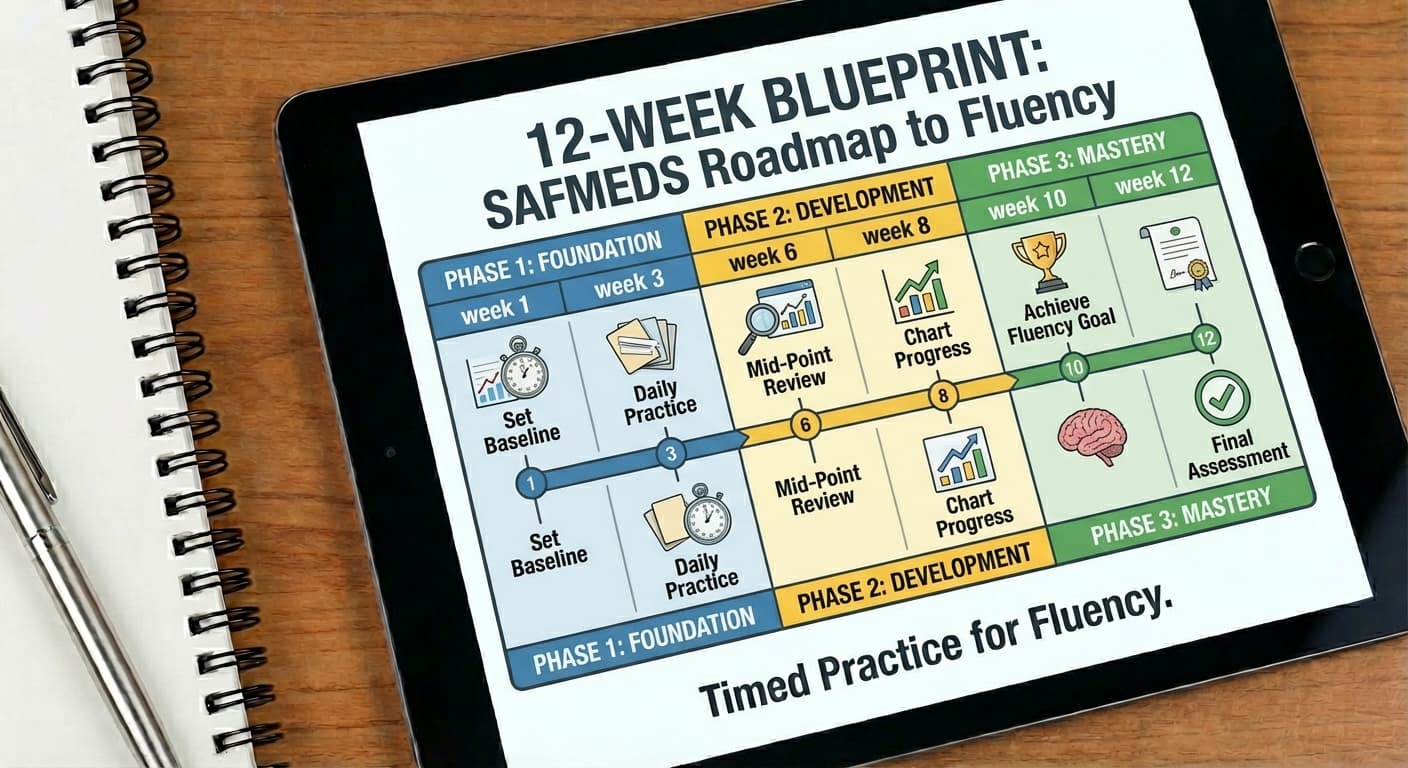
Your 60-Second Transformation Plan
Ready to experience the difference timed practice makes? Here's how to start:
Week 1: Establish Baseline
- Complete 3 one-minute timings daily
- Record your average count per minute
- Don't worry about speed—just practice the protocol
Weeks 2-4: Build Speed
- Push faster each session
- Accept some errors as the price of speed
- Watch your celeration on the chart
- Aim for at least 10% improvement weekly
Week 5+: Maintain and Extend
- Continue daily practice
- Add new content as fluency develops
- Set fluency aims for your channel (typed terminology typically 15-25/min; spoken 40-60/min)
- Trust the process—automaticity emerges with consistency
Conclusion
The 60-second timing isn't just a convenient duration—it's a precisely calibrated tool for building fluent, automatic knowledge. It generates enough data for meaningful measurement while maintaining peak effort. It creates optimal challenge that pushes you beyond comfortable, deliberate processing into genuine automaticity.
Traditional untimed study feels productive but builds fragile knowledge that fails under pressure. Timed practice feels intense but builds durable knowledge that performs when it matters.
The science is clear:
- Retrieval practice strengthens memory (testing effect)
- Speed training builds automaticity (controlled → automatic processing)
- 60 seconds optimizes the balance (data quality + effort maintenance)
- RESA outcomes require fluency (not just accuracy)
Every 60-second timing is an investment in knowledge that will actually be there when you need it. That's why 60 seconds changes everything.
Start your timed practice today with TAFMEDS and experience the difference fluency makes.
Related Articles
- What is SAFMEDS? The Complete Guide - The full methodology explained
- Understanding the Standard Celeration Chart - Track your progress scientifically
- 5 Common SAFMEDS Mistakes - Avoid the pitfalls that slow progress
References
- Binder, C. (1996). Behavioral fluency: Evolution of a new paradigm. *The Behavior Analyst, 19*(2), 163-197.
- Bjork, E. L., & Bjork, R. A. (2011). Making things hard on yourself, but in a good way: Creating desirable difficulties to enhance learning. In M. A. Gernsbacher, R. W. Pew, L. M. Hough, & J. R. Pomerantz (Eds.), *Psychology and the real world: Essays illustrating fundamental contributions to society* (pp. 56-64). Worth Publishers.
- Guadagnoli, M. A., & Lee, T. D. (2004). Challenge point: A framework for conceptualizing the effects of various practice conditions in motor learning. *Journal of Motor Behavior, 36*(2), 212-224.
- Lindsley, O. R. (1992). Precision teaching: Discoveries and effects. *Journal of Applied Behavior Analysis, 25*(1), 51-57.
- Roediger, H. L., & Karpicke, J. D. (2006). Test-enhanced learning: Taking memory tests improves long-term retention. *Psychological Science, 17*(3), 249-255.
- White, O. R., & Haring, N. G. (1980). *Exceptional teaching* (2nd ed.). Columbus, OH: Merrill.