You practice every day. Your scores are going up. But how fast are you actually learning? And how does your learning rate compare to what's possible?
Most students track their performance—today's score, this week's average, their personal best. But performance is just a snapshot. What matters more is the *rate of change* in your performance over time.
That rate of change has a name: celeration. And understanding it transforms how you approach learning.
What Is Celeration?
The Basic Concept
Celeration measures how quickly your performance is changing. It answers the question: "How much better am I getting per unit of time?"
Think of it like velocity in physics:
- Performance = where you are (like position)
- Celeration = how fast you're improving (like velocity)
A student scoring 10 correct per minute with high celeration will soon outperform a student scoring 14 correct per minute with low celeration. The rate of improvement predicts future success better than current performance.
Why "Celeration" Instead of "Acceleration"?
Ogden Lindsley, founder of Precision Teaching, coined "celeration" to describe the multiplicative rate of change on a Standard Celeration Chart. Unlike acceleration (which is additive), celeration describes proportional change.
| Concept | Type of Change | Example |
|---|---|---|
| Acceleration | Additive | Improving by +5 per week |
| Celeration | Multiplicative | Improving by x1.5 per week |
Multiplicative change is more natural for learning. A beginner improving from 10 to 15 (50% increase) and an advanced learner improving from 40 to 60 (50% increase) show the same celeration, even though the absolute gains differ.
How Celeration Works on the Standard Celeration Chart
The Logarithmic Scale
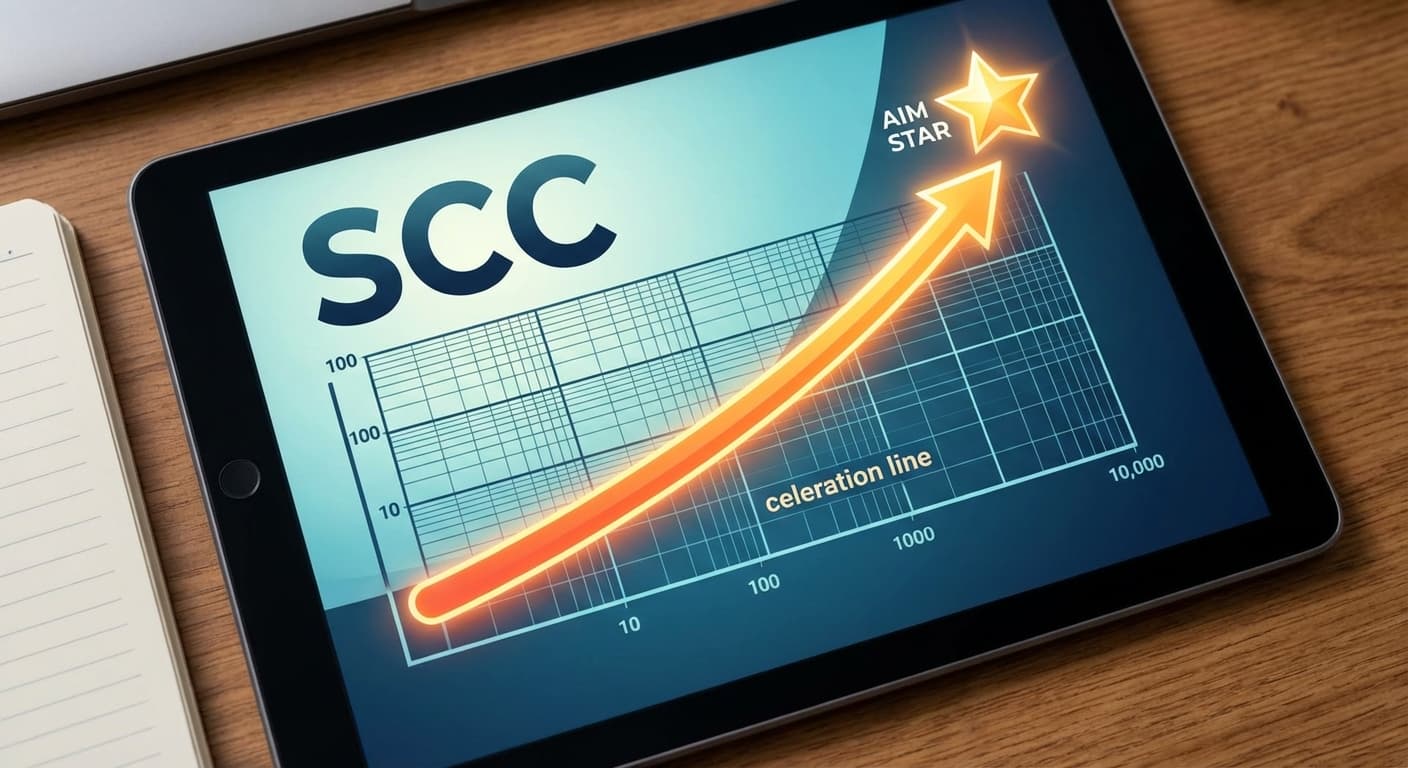
The Standard Celeration Chart uses a semi-logarithmic scale—time is linear (across), but frequency is logarithmic (up and down). On this scale:
- Equal vertical distances represent equal *proportional* changes
- A straight line indicates constant celeration
- The slope of the line reveals the celeration value
Reading Celeration Visually
| Line Appearance | Celeration | Interpretation |
|---|---|---|
| Steep upward slope | High positive | Rapid improvement |
| Gentle upward slope | Low positive | Slow improvement |
| Horizontal line | x1.0 | No change |
| Downward slope | Less than x1.0 | Performance declining |
The Celeration Turn
A celeration turn is when your learning rate changes—the line bends. This indicates something significant happened:
- Upward turn: Something improved your learning conditions
- Downward turn: Something is interfering with progress
- Flattening: Approaching ceiling or hitting a barrier
Identifying celeration turns helps you understand what's working and what isn't.
Calculating Celeration
The Basic Formula
Celeration is calculated as a ratio between two performance levels separated by a standard time period (usually one week):
```
Celeration = Performance at End of Period / Performance at Start of Period
```
Example:
- Monday: 25 correct/minute
- Following Monday: 35 correct/minute
- Celeration = 35/25 = x1.4 per week
This learner improved by 40% in one week.
Standard Time Periods
| Period | Use Case |
|---|---|
| Daily celeration | Short-term analysis, troubleshooting |
| Weekly celeration | Standard measure, most research uses this |
| Monthly celeration | Long-term trend analysis |
Weekly celeration is the standard because it:
- Smooths out day-to-day variation
- Aligns with natural learning cycles
- Matches most research conventions
Finding Celeration from Chart Data
On a Standard Celeration Chart:
- Draw a trend line through your data points (best fit line)
- Find the frequency finder on your chart
- Place the finder so the line passes through it
- Read the celeration where your trend line crosses the finder scale
Most charting software (including TAFMEDS) calculates this automatically.
Interpreting Celeration Values
What Do the Numbers Mean?
| Weekly Celeration | Interpretation | What to Do |
|---|---|---|
| x2.0 or higher | Exceptional learning | Maintain current conditions |
| x1.5 - x2.0 | Excellent learning | This is the target range |
| x1.25 - x1.5 | Good learning | Acceptable, could improve |
| x1.1 - x1.25 | Slow learning | Consider changing approach |
| x1.0 | No improvement | Something needs to change |
| Below x1.0 | Declining | Identify and address barriers |
Target Celeration for SAFMEDS
Research on fluency building suggests optimal weekly celeration of x1.5 to x2.0 for most learners. This means:
- Doubling performance every 1-2 weeks
- Reaching fluency aims within 2-4 weeks
- Maintaining motivation through visible progress
Comparing Celeration Across Learners
Because celeration is proportional, you can fairly compare:
- Beginners and advanced learners
- Easy and difficult content
- Different deck sizes
A beginner with x1.6 celeration is learning just as effectively as an expert with x1.6 celeration—they're both improving at 60% per week.
Factors That Affect Celeration
Positive Factors (Increase Celeration)
| Factor | Why It Helps |
|---|---|
| Daily practice | Maximizes consolidation, prevents decay |
| Proper timing | Timed practice builds speed, not just accuracy |
| Good shuffling | Prevents positional learning artifacts |
| Appropriate deck size | Not too easy, not overwhelming |
| Quality cards | Clear stimuli, precise responses |
| Optimal sleep | Memory consolidation requires sleep |
| Low stress | Stress impairs learning and memory |
Negative Factors (Decrease Celeration)
| Factor | Why It Hurts |
|---|---|
| Inconsistent practice | Forgetting undermines progress |
| Untimed practice | No urgency to build speed |
| Poor card quality | Ambiguity creates confusion |
| Too many cards | Overwhelm prevents mastery |
| Fatigue | Tired practice is ineffective |
| Distractions | Divided attention impairs encoding |
The Celeration Ceiling
As you approach your fluency aim, celeration naturally decreases. This is normal:
- Early practice: Lots of room to improve = high celeration
- Mid practice: Steady progress = moderate celeration
- Near fluency: Approaching ceiling = low celeration
Don't expect x2.0 celeration when you're already at 80% of your aim.
Using Celeration to Make Decisions
The Decision Framework
Celeration tells you whether your current approach is working:
| Your Celeration | Current Performance | Action |
|---|---|---|
| Strong (x1.5+) | Below aim | Continue—you'll reach aim soon |
| Strong (x1.5+) | At/near aim | Celebrate! Consider raising aim |
| Weak (x1.0-1.25) | Below aim | Change something—current approach isn't working |
| Weak (x1.0-1.25) | At/near aim | You may have reached appropriate fluency |
| Declining (<x1.0) | Any level | Investigate immediately—something's wrong |
Diagnosing Low Celeration
When celeration is below target, systematically check:
- Practice consistency: Are you practicing every day?
- Practice quality: Timed? Shuffled? Focused?
- Card quality: Clear? Appropriate difficulty?
- Physical factors: Sleep? Stress? Health?
- Motivation: Engagement? Burnout?
Address the most likely cause first, then monitor celeration for improvement.
When to Change vs. When to Wait
Change approach when:
- Your daily frequencies fall below your projected celeration line for more than two days in a row. This is the sourced change rule: precision teachers kept a program running while the data did not drop under the projected minimum line for more than two consecutive days (Binder, 1996)
- A whole phase settles under x1.25 per week. Van and Kubina (2026) use that as a conservative cut-off for calling a celeration meaningful — an after-the-fact judgement read alongside level and bounce, not a trigger on its own
- You've identified a specific problem to address
- Performance is plateaued with no sign of improvement
Wait and observe when:
- You just started with new content (allow baseline establishment)
- You recently made a change (allow time to see effects)
- Celeration is acceptable but you want better
Pro Tip
Celeration in Practice: Case Studies
Case 1: The Steady Learner
Profile:
- Starting performance: 6 correct/minute (typed channel)
- Weekly celeration: x1.3 consistently
- Practice: Daily, proper technique
Trajectory:
| Week | Performance | Notes |
|---|---|---|
| 1 | 6/min | Baseline |
| 2 | 8/min | On track |
| 3 | 10/min | On track |
| 4 | 13/min | Approaching aim |
| 5 | 16/min | At aim (15+) |
Outcome: Reached fluency in 5 weeks with consistent, sustainable practice.
Case 2: The Struggling Learner
Profile:
- Starting performance: 5 correct/minute (typed channel)
- Weekly celeration: x1.1 (first 3 weeks)
- Practice: Most days, sometimes untimed
Diagnosis: Inconsistent timing and missed practice days
Intervention: Committed to daily timed practice
Result: Celeration improved to x1.5, reached fluency by week 8
Case 3: The Plateau
Profile:
- Starting performance: 7 correct/minute (typed channel)
- Reached 12/minute by week 3
- Celeration dropped to x1.0 for weeks 4-6
Diagnosis: Deck too small (only 15 cards), positional learning
Intervention: Added 20 new cards, emphasized shuffling
Result: Celeration rebounded to x1.3, reached aim by week 9
Tracking Celeration with TAFMEDS
Automatic Calculation
TAFMEDS calculates your celeration automatically:
- Daily celeration: Shown in session summaries
- Weekly celeration: Displayed on your progress dashboard
- Trend analysis: Visual representation on your Standard Celeration Chart
Using Celeration Data
In TAFMEDS, use your celeration data to:
- Identify your strongest decks: Where is celeration highest?
- Spot struggling areas: Where has celeration dropped?
- Predict fluency timelines: When will you reach your aims?
- Validate changes: Did your intervention improve celeration?
Setting Celeration Targets
When creating practice goals, include celeration targets:
- Minimum acceptable: x1.25 per week
- Target: x1.5-1.75 per week
- Stretch goal: x2.0 per week
If you consistently fall below minimum, it's time to diagnose and adjust.
Common Celeration Mistakes
Mistake 1: Ignoring Early Low Celeration
Problem: "I just started, low celeration is normal."
Reality: While very high celeration isn't expected on day one, persistently low celeration (x1.1 or below) for the first 2 weeks indicates a problem with practice conditions.
Fix: Ensure proper technique from the start.
Mistake 2: Expecting Constant High Celeration
Problem: "My celeration dropped from x1.8 to x1.3—something's wrong!"
Reality: Celeration naturally decreases as you approach fluency. The learning curve isn't linear.
Fix: Evaluate celeration relative to your distance from the aim.
Mistake 3: Changing Too Quickly
Problem: Adjusting approach every few days based on celeration fluctuations.
Reality: Daily celeration varies naturally. Weekly trends are more meaningful.
Fix: Make decisions based on weekly celeration patterns, not daily swings.
Mistake 4: Not Tracking Celeration at All
Problem: "I just look at my scores."
Reality: Without celeration data, you can't tell if your learning is efficient or predict when you'll reach fluency.
Fix: Use a system (like TAFMEDS) that tracks celeration automatically.
Your Celeration Action Plan
This Week
- Calculate your current celeration: Compare this week's average to last week's
- Evaluate against targets: Are you at x1.25 or above?
- Identify one improvement: What could boost your celeration?
Ongoing Monitoring
- Check your celeration at least once a week. Sunday is the chart's week line, not a prescribed review day — pick whichever day you will actually keep
- Note celeration turns: When does your learning rate change?
- Correlate with conditions: What factors affect your celeration?
Long-Term Tracking
- Document your patterns: What celeration is typical for you?
- Compare across content: Where do you learn fastest?
- Use data for planning: Predict fluency timelines based on celeration
Conclusion
Celeration transforms learning from a vague feeling of "getting better" into a precise, measurable process. It answers the critical questions:
- Am I improving? (Celeration above x1.0)
- Am I improving fast enough? (Celeration at x1.25+)
- Am I improving optimally? (Celeration at x1.5-2.0)
- When will I reach fluency? (Project current celeration forward)
Without celeration, you're flying blind—you know where you are but not how fast you're moving or when you'll arrive. With celeration, you have a speedometer for learning.
The data doesn't lie. Trust it, use it, and let it guide your practice decisions. Your celeration tells you whether your effort is translating into results—and if it isn't, it's the first signal that something needs to change.
What's your celeration this week?
Track your celeration automatically with TAFMEDS—see exactly how fast you're learning and predict when you'll reach fluency.
Related Articles
- Understanding the Standard Celeration Chart - The tool that displays celeration
- Setting Fluency Aims - What you're accelerating toward
- Why 60 Seconds Changes Everything - Timed practice that enables celeration measurement
References
- Calkin, A. B. (2005). Precision teaching: The standard celeration charts. *The Behavior Analyst Today, 6*(4), 207-215.
- Graf, S., & Lindsley, O. R. (2002). *Standard Celeration Charting 2002*. Youngstown, OH: Graf Implements.
- Johnson, K. R., & Street, E. M. (2004). The Morningside Model of Generative Instruction. *Concord, MA: Cambridge Center for Behavioral Studies*.
- Kubina, R. M., & Yurich, K. K. L. (2012). *The Precision Teaching Book*. Lemont, PA: Greatness Achieved.
- Lindsley, O. R. (1992). Precision teaching: Discoveries and effects. *Journal of Applied Behavior Analysis, 25*(1), 51-57.
- White, O. R. (1986). Precision Teaching—Precision Learning. *Exceptional Children, 52*(6), 522-534.
- Binder, C. (1996). Behavioral fluency: Evolution of a new paradigm. *The Behavior Analyst, 19*(2), 163-197.
- Van, J., & Kubina, R. M., Jr. (2026). Measuring change in private events: A review of precision teaching interventions for inner behavior. *Behavior and Social Issues, 35*, 144-166.