Every SAFMEDS session generates data—counts, accuracy, trends over time. Most students glance at their numbers and move on. They're missing the point.
Data isn't just for tracking; it's for deciding. Your practice data tells you what's working, what's failing, and what needs to change. Used well, it transforms SAFMEDS from hopeful practice into precision learning.
This guide teaches you to read, interpret, and act on your learning data—making decisions that accelerate your path to fluency.
Why Data-Based Decisions Matter
The Alternative: Feeling-Based Decisions
Without data, decisions rely on subjective feeling:
| Feeling-Based | Data-Based |
|---|---|
| "I think I'm improving" | "My celeration is x1.4 this week" |
| "This deck feels harder" | "My accuracy on this deck is 78% vs. 91%" |
| "I'm probably ready for the exam" | "I've achieved fluency aims on 8/10 decks" |
| "Something's wrong but I don't know what" | "Errors increased when I switched to evening practice" |
Feelings are unreliable indicators of learning. Research on metacognition consistently shows people are poor judges of their own knowledge. Data provides objectivity.
The Precision Teaching Foundation
SAFMEDS inherits data-based decision making from Precision Teaching, which holds:
- The learner knows best: Data reveals what's working better than theories
- The data doesn't lie: Objective measurement trumps subjective judgment
- Change happens when data shows need: Not based on schedules or assumptions
This philosophy applies to your own learning. Let your data guide your decisions.
Understanding Your Core Metrics
Count Per Minute (Frequency)
What it is: Number of correct responses in 60 seconds
What it tells you:
- Current performance level
- Speed of retrieval
- Progress toward fluency aim
How to interpret (typed-channel rates — spoken practice runs 2-3x higher):
| Count | Interpretation |
|---|---|
| Below 6/min | Building foundation; not yet fluent |
| 6-10/min | Developing; approaching functional level |
| 10-15/min | Solid performance; nearing fluency |
| 15+/min | Fluent for most short-answer content |
Accuracy (Percent Correct)
What it is: Correct responses ÷ Total responses × 100
What it tells you:
- Knowledge reliability
- Whether speed is outpacing accuracy
How to interpret:
| Accuracy | Interpretation |
|---|---|
| Below 80% | Too many errors; may be building wrong responses |
| 80-90% | Acceptable; normal while building speed |
| 90-95% | Good balance of speed and accuracy |
| Above 95% | Excellent accuracy; may be able to push speed more |
Celeration (Learning Rate)
What it is: Rate of change in performance over time (weekly)
What it tells you:
- How fast you're learning
- Whether current approach is working
- Predicted time to reach aims
How to interpret:
| Weekly Celeration | Interpretation |
|---|---|
| Below x1.1 | Stagnant; something needs to change |
| x1.1 - x1.25 | Slow improvement; could be better |
| x1.25 - x1.5 | Good progress; acceptable rate |
| x1.5 - x2.0 | Excellent progress; maintain conditions |
| Above x2.0 | Rapid improvement; very effective approach |
Error Patterns
What to track:
- Which cards consistently cause errors
- When errors occur (beginning vs. end of timing)
- Types of errors (confusion between cards, blank, wrong answer)
What it tells you:
- Specific knowledge gaps
- Fatigue effects
- Card quality issues
Reading the Standard Celeration Chart
Basic Chart Interpretation
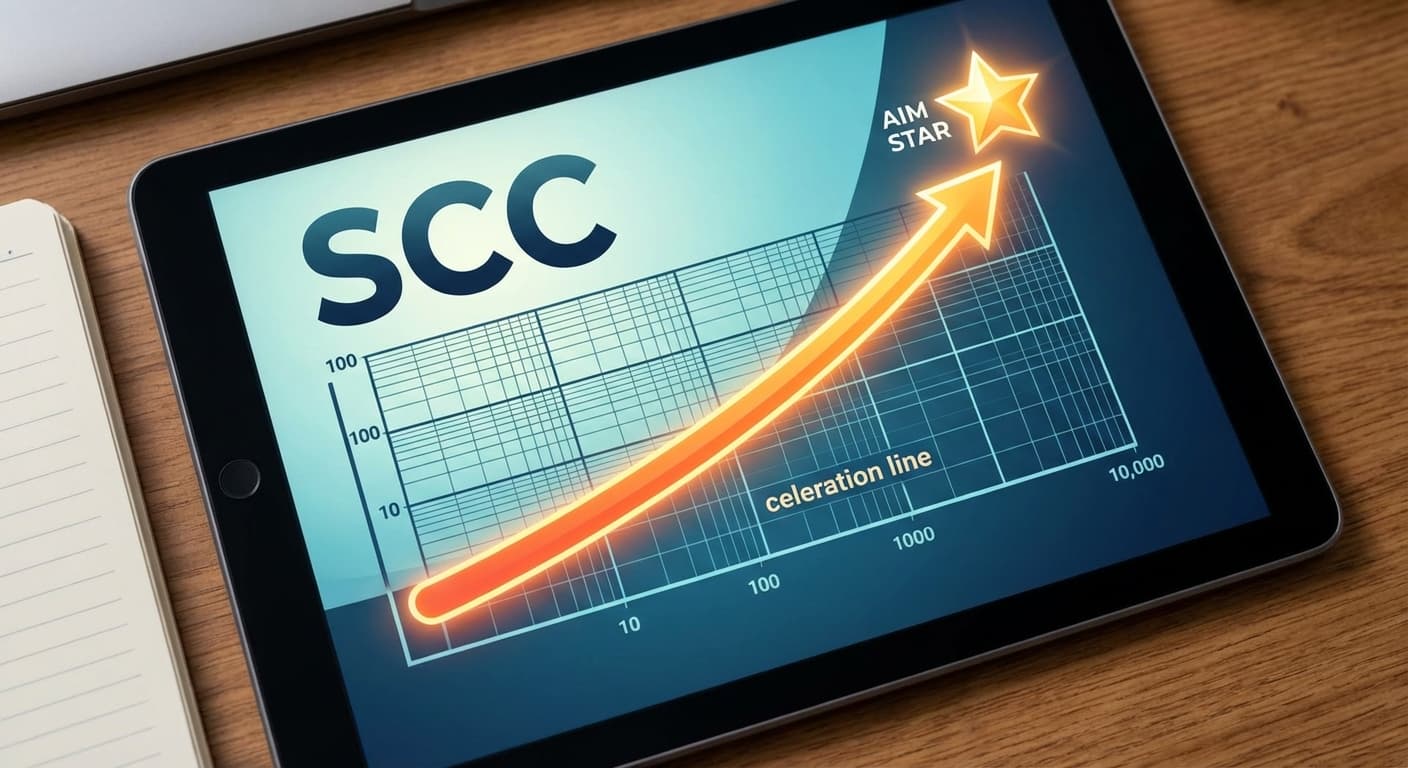
The Standard Celeration Chart displays:
- Horizontal axis: Calendar time (days)
- Vertical axis: Frequency (logarithmic scale)
- Correct data: Plotted dots
- Error data: Plotted X's
- Trend lines: Best fit through data points
What the Chart Shows
| Pattern | What It Means | What to Do |
|---|---|---|
| Steady upward trend | Consistent improvement | Continue current approach |
| Upward trend steepening | Accelerating improvement | Note what changed; replicate |
| Upward trend flattening | Decelerating improvement | Check for ceiling effects or barriers |
| Flat trend | No improvement | Change something—current approach isn't working |
| Downward trend | Performance declining | Investigate immediately |
| High variability | Inconsistent performance | Stabilize practice conditions |
| Errors decreasing as corrects increase | Healthy learning pattern | Ideal pattern—continue |
| Errors staying flat while corrects increase | Speed outpacing accuracy | May need to consolidate before pushing more |
Celeration Lines
Drawing a celeration line (trend line) through your data reveals your learning rate at a glance:
- Steeper line = faster learning
- Line angle indicates celeration multiplier
- Changes in angle indicate changes in learning rate
TAFMEDS calculates this automatically, showing your celeration value directly.
Making Data-Based Decisions
Decision 1: Is This Deck Working?
Data to check: Weekly celeration, read against your projected celeration line
Decision criteria:
| Signal | Decision |
|---|---|
| x1.5+ sustained | Deck is working; continue |
| x1.25-1.5 sustained | Deck is adequate; consider improvements |
| Under x1.25 across the whole phase | Below the conservative cut-off for a meaningful celeration that Van and Kubina (2026) propose; read it with level and bounce before acting |
| More than two days in a row below your projected celeration line | The sourced change trigger (Binder, 1996); intervene |
If intervention needed, check:
- Practice consistency (are you practicing daily?)
- Practice quality (timed? shuffled? focused?)
- Card quality (clear? appropriate difficulty?)
- Deck size (too large? too small?)
Decision 2: Am I Ready to Move On?
Data to check: Performance relative to fluency aim + retention test
Decision criteria:
- Consistently meeting aim (3+ sessions)
- Accuracy maintained (85%+)
- Performance stable (low session-to-session variability)
- Retention holds after break
If yes: Add new content or advance to maintenance schedule
If no: Continue until criteria met
Decision 3: What's Causing This Problem?
When performance isn't meeting expectations, diagnose systematically:
Step 1: Characterize the problem
| Symptom | Possible Causes |
|---|---|
| Low celeration, okay accuracy | Deck too easy; need more challenge |
| Declining accuracy | Moving too fast; need consolidation |
| High variability | Inconsistent practice conditions |
| Sudden drop | External factor; check recent changes |
| Plateau near aim | Approaching ceiling; may need different strategy |
Step 2: Check potential causes
- Practice logs (consistency, timing, conditions)
- Card quality review
- External factors (stress, sleep, life events)
Step 3: Make one change
- Change one variable at a time
- Monitor for at least one week
- Compare celeration before/after
Decision 4: Which Deck Needs Attention?
When practicing multiple decks, prioritize based on data:
| Priority | Criteria |
|---|---|
| High | Low celeration + far from aim |
| Medium | Adequate celeration + far from aim |
| Medium | Low celeration + near aim |
| Low | Adequate celeration + near aim |
| Maintenance | At aim + stable |
Allocate more practice time to high-priority decks.
Data Patterns and Their Meanings
The Healthy Learning Curve
Pattern: Steep initial improvement, gradually flattening as aim approached
What it means: Normal learning trajectory—rapid gains when much room to improve, slower gains near ceiling
What to do: Continue; expect flattening near aim
The Plateau
Pattern: Performance flat for extended period (2+ weeks)
Possible causes:
- Deck too easy (ceiling effect)
- Deck too hard (frustration effect)
- Practice conditions suboptimal
- Wrong aim (too high or too low)
- Knowledge gap requiring different approach
What to do: Diagnose cause; intervene accordingly
The Regression
Pattern: Performance declining after previous gains
Possible causes:
- Practice consistency disrupted
- External stressors
- Fatigue or burnout
- Card deck issues (e.g., added difficult cards)
What to do: Identify what changed; address root cause
The Sawtooth
Pattern: Performance varies dramatically session to session
Possible causes:
- Inconsistent practice conditions (time, location, alertness)
- Deck contains mix of easy and hard cards
- Rushing some sessions, not others
What to do: Stabilize practice conditions; consider deck reorganization
The Breakthrough
Pattern: Sudden performance jump after period of slow growth
What it means: Consolidation completed; new level of automaticity achieved
What to do: Celebrate and maintain new level
Data Review Routines
Daily Review (1 minute)
After each session:
- Note today's count and accuracy
- Compare to yesterday
- Quick assessment: On track? Concern?
Weekly Review (10 minutes)
Each week:
- Calculate weekly celeration (or review TAFMEDS calculation)
- Compare to target celeration (x1.25+)
- Identify decks needing attention
- Adjust next week's focus if needed
Weekly review questions:
- Which decks are progressing well?
- Which decks are struggling?
- Are my practice conditions consistent?
- What will I adjust next week?
Monthly Review (30 minutes)
Each month:
- Review overall progress toward goals
- Check retention on older content
- Assess timeline to fluency aims
- Major strategy adjustments if needed
Monthly review questions:
- Am I on track for my overall goal (exam, certification)?
- Which content areas are strongest/weakest?
- Is my study plan still appropriate?
- What have I learned about my learning?
Common Data Interpretation Mistakes
Mistake 1: Overreacting to Single Data Points
Problem: One bad session triggers major changes
Reality: Individual sessions vary; trends matter more than points
Fix: Make decisions based on weekly patterns, not daily fluctuations
Mistake 2: Ignoring the Data
Problem: Practice without ever reviewing performance
Reality: You're missing crucial feedback
Fix: Build data review into your routine
Mistake 3: Focusing Only on Count
Problem: Celebrating high counts regardless of accuracy
Reality: High count with low accuracy means practiced errors
Fix: Monitor count AND accuracy together
Mistake 4: Not Tracking Across Time
Problem: Only looking at today's performance, not trends
Reality: Celeration (trend) predicts future success better than current level
Fix: Use charting that shows trends over time
Mistake 5: Changing Too Many Things at Once
Problem: Multiple simultaneous changes make it impossible to know what helped
Reality: Scientific approach requires changing one variable at a time
Fix: Change one thing, observe for a week, then evaluate
Using TAFMEDS Data Features
Dashboard Analytics
TAFMEDS provides:
- Session summaries: Immediate feedback after each timing
- Trend visualization: Standard Celeration Chart display
- Celeration calculation: Automatic weekly celeration
- Progress toward aims: Visual representation of goal progress
- Cross-deck comparison: See which decks need attention
Making the Most of Your Data
Before practice:
- Check which deck needs attention based on recent performance
- Note your goal for this session
After practice:
- Review session data immediately
- Compare to recent sessions
- Note anything unusual
Weekly:
- Review dashboard analytics
- Make strategic adjustments based on data
- Plan next week's focus
From Data to Action: Decision Flowchart
When reviewing your data, follow this decision process:
Step 1: Is celeration adequate (x1.25+)?
- Yes → Continue current approach
- No → Go to Step 2
Step 2: Is accuracy adequate (85%+)?
- Yes → Push for more speed
- No → Focus on accuracy before speed
Step 3: Is practice consistent (daily)?
- Yes → Go to Step 4
- No → Address consistency first
Step 4: Are cards appropriate?
- Check clarity, difficulty, formatting
- Revise problem cards
Step 5: Are conditions optimal?
- Check timing, environment, focus
- Optimize conditions
Step 6: Still struggling?
- Consider content difficulty
- May need prerequisite knowledge
- Seek help if available
Conclusion
Your SAFMEDS data is a conversation between you and your learning. It tells you:
- What's working (keep doing it)
- What's failing (change it)
- How fast you're progressing (is it enough?)
- When you'll reach your goals (stay on track)
Data-based decision making transforms practice from hopeful effort into precision skill-building. Instead of wondering if you're improving, you know. Instead of guessing what to change, you diagnose systematically.
The data-driven learner:
- Practices consistently to generate meaningful data
- Reviews data regularly (daily, weekly, monthly)
- Interprets patterns, not just numbers
- Makes decisions based on evidence, not feeling
- Changes one thing at a time and observes results
- Uses data to predict and plan
Trust your data more than your feelings. Your feelings will tell you that familiar content is learned (it may not be) and that hard practice isn't working (it probably is). The data reveals the truth.
Let the data guide you to fluency.
Track and analyze your learning with TAFMEDS—data-driven practice for measurable results.
Related Articles
- Celeration: Measuring Your True Learning Rate - Deep dive on learning rate
- Understanding the Standard Celeration Chart - Reading the visual display
- Setting Fluency Aims - What you're measuring progress toward
References
- Binder, C. (1996). Behavioral fluency: Evolution of a new paradigm. *The Behavior Analyst, 19*(2), 163-197.
- Calkin, A. B. (2005). Precision teaching: The standard celeration charts. *The Behavior Analyst Today, 6*(4), 207-215.
- Graf, S., & Lindsley, O. R. (2002). *Standard Celeration Charting 2002*. Youngstown, OH: Graf Implements.
- Kubina, R. M., & Yurich, K. K. L. (2012). *The Precision Teaching Book*. Lemont, PA: Greatness Achieved.
- Lindsley, O. R. (1992). Precision teaching: Discoveries and effects. *Journal of Applied Behavior Analysis, 25*(1), 51-57.
- White, O. R. (1986). Precision Teaching—Precision Learning. *Exceptional Children, 52*(6), 522-534.
- Vargas, J. S. (2009). *Behavior analysis for effective teaching*. Routledge.
- Van, J., & Kubina, R. M., Jr. (2026). Measuring change in private events: A review of precision teaching interventions for inner behavior. *Behavior and Social Issues, 35*, 144-166.