Ethics questions comprise 12-15% of the BCBA and BCaBA exams—making ethics one of the highest-weighted content areas. Yet many candidates underestimate ethics preparation, assuming ethical behavior is "common sense."
It's not. The Ethics Code for Behavior Analysts contains specific standards, hierarchies, and decision-making frameworks that differ from intuitive ethical reasoning. Exam questions test your knowledge of these specific standards, not your general sense of right and wrong.
This guide provides a systematic approach to ethics preparation: understanding the code structure, mastering key standards, recognizing common scenarios, and building fluency for exam success.
Understanding the Ethics Code Structure
Code Organization
The Ethics Code for Behavior Analysts (effective January 2022) contains:
- Core Principles: Four fundamental values guiding ethical practice
- Ethics Standards: Specific behavioral requirements organized into sections
- Glossary: Definitions of key terms
| Section | Focus Area |
|---|---|
| 1 | Responsibility as a Professional |
| 2 | Responsibility in Practice |
| 3 | Responsibility to Clients and Stakeholders |
| 4 | Responsibility to Supervisees and Trainees |
| 5 | Responsibility in Public Statements |
| 6 | Responsibility in Research |
The Four Core Principles
These principles underlie all ethics standards:
- Benefit Others: Behavior analysts work to maximize benefit
- Treat Others with Compassion, Dignity, and Respect: Fundamental human values
- Behave with Integrity: Honesty, transparency, professional conduct
- Ensure Their Competence: Practice within boundaries of training
High-Yield Ethics Standards
Section 1: Responsibility as a Professional
Key standards:
| Standard | Requirement |
|---|---|
| 1.01 | Being truthful |
| 1.02 | Conforming with legal and professional requirements |
| 1.04 | Integrity in relationships |
| 1.05 | Maintaining competence through professional development |
| 1.06 | Addressing behavior that harms clients |
| 1.07 | Cultural responsiveness and diversity |
Common exam scenarios:
- What to do when asked to practice outside your competence
- How to handle discovering a colleague's ethical violation
- Maintaining professional boundaries
Section 2: Responsibility in Practice
Key standards:
| Standard | Requirement |
|---|---|
| 2.01 | Providing effective treatment |
| 2.03 | Timeliness of services |
| 2.04 | Disclosing conflicts of interest |
| 2.05 | Documentation and record keeping |
| 2.08 | Communicating about services |
| 2.09 | Involving clients in service decisions |
| 2.10 | Collaborating with colleagues |
| 2.11 | Addressing harmful reinforcement contingencies |
| 2.13 | Selecting, designing, and implementing assessments |
| 2.14 | Designing and implementing behavior-change interventions |
| 2.15 | Minimizing risk of behavior-change interventions |
| 2.16 | Describing conditions for program success |
Common exam scenarios:
- Choosing between effective but aversive procedures vs. less effective but less restrictive
- When to discontinue services
- Handling insurance/funding conflicts with best practice
Section 3: Responsibility to Clients and Stakeholders
Key standards:
| Standard | Requirement |
|---|---|
| 3.01 | Responsibility to clients |
| 3.03 | Accepting clients |
| 3.04 | Obtaining consent |
| 3.05 | Confidentiality and its limits |
| 3.06 | Protecting client documentation |
| 3.07 | Multiple relationships and conflicts of interest |
| 3.08 | Gifts, fees, and financial arrangements |
| 3.10 | Continuity of services |
| 3.11 | Discontinuing services |
| 3.12 | Appropriately transitioning services |
Common exam scenarios:
- Who is the client when there are multiple stakeholders?
- Managing confidentiality with minor clients
- Handling requests that conflict with client welfare
Section 4: Responsibility to Supervisees and Trainees
Key standards:
| Standard | Requirement |
|---|---|
| 4.01 | Compliance with supervision requirements |
| 4.02 | Supervisory competence |
| 4.03 | Providing supervision |
| 4.04 | Accountability in supervision |
| 4.05 | Maintaining supervision documentation |
| 4.06 | Providing supervision for experience hours |
| 4.07 | Terminating supervision |
Common exam scenarios:
- What constitutes appropriate supervision
- When to terminate a supervisory relationship
- Supervisor responsibilities for supervisee conduct
Section 5: Responsibility in Public Statements
Key standards:
| Standard | Requirement |
|---|---|
| 5.01 | Protecting rights of clients in public statements |
| 5.02 | Public statements |
| 5.03 | Advertising |
Common exam scenarios:
- What can/cannot be included in professional advertising
- Using client testimonials
- Social media conduct
Section 6: Responsibility in Research
Key standards:
| Standard | Requirement |
|---|---|
| 6.01 | Conforming with research ethics |
| 6.02 | Research with human subjects |
| 6.03 | Research with animal subjects |
| 6.04 | Accuracy in research |
Common exam scenarios:
- IRB requirements
- Informed consent in research
- Authorship and plagiarism
Ethics Decision-Making Framework
The Hierarchy of Concerns
When ethical obligations conflict, follow this priority:
- Client welfare and rights (highest priority)
- Professional responsibilities
- Organizational requirements
- Personal preferences (lowest priority)
Exam Decision-Making Strategy
For ethics questions:
- Identify the ethical issue: What standard is potentially being violated?
- Identify stakeholders: Who is affected? Who is the client?
- Apply the hierarchy: When interests conflict, whose welfare takes priority?
- Consider the code: What does the specific standard require?
- Choose the BEST answer: Multiple options may be defensible; pick the best one
Red Flags in Answer Choices
Usually wrong:
- Options that prioritize convenience over client welfare
- Options that avoid addressing the problem
- Options that involve deception
- Options with absolute terms ("always," "never") unless directly from the code
Usually right:
- Options that address the issue directly
- Options that prioritize client welfare
- Options that involve consultation or supervision when uncertain
- Options that follow specific code requirements
Building Fluency in Ethics
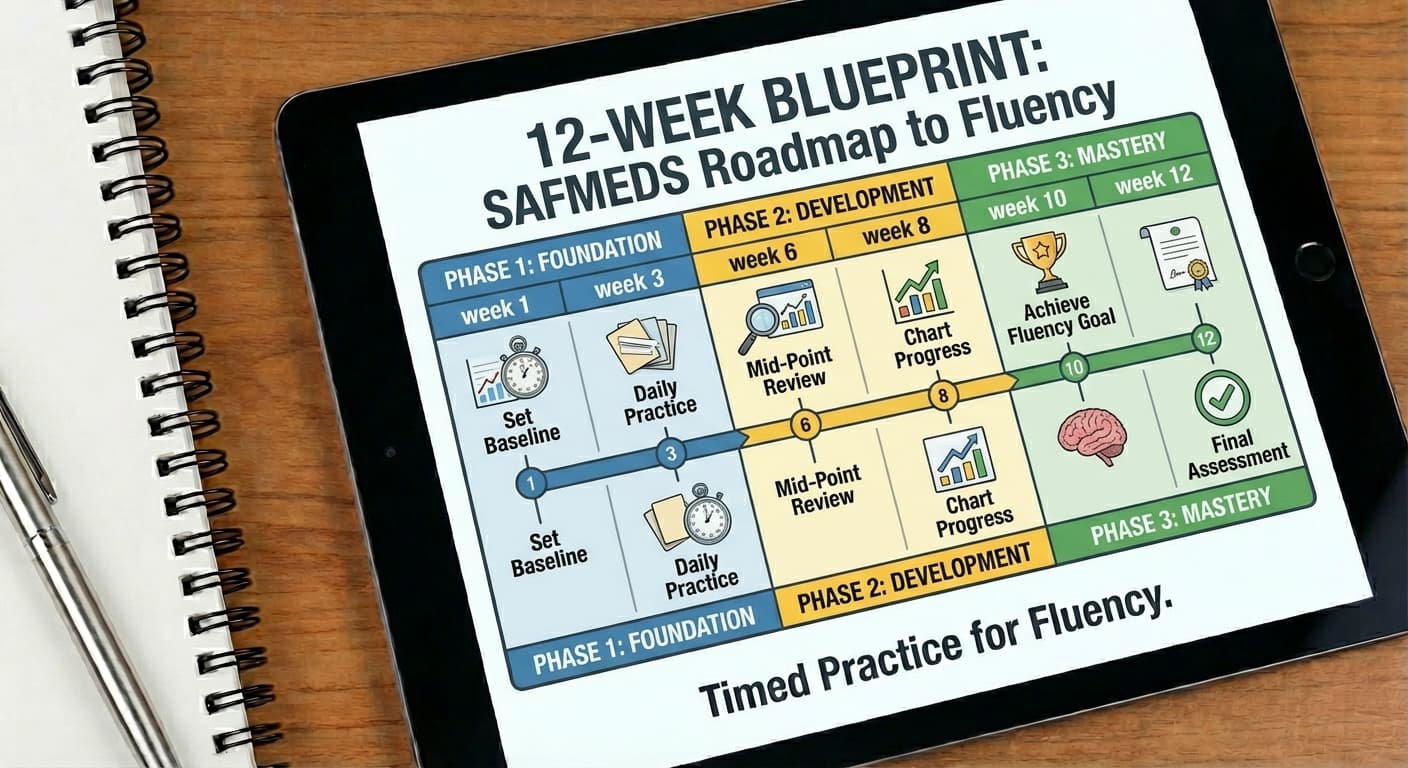
SAFMEDS for Ethics Standards
Create cards for rapid recall:
Standard identification cards:
- Front: "Code standard: Requirement to report colleague's harmful conduct"
- Back: "1.06 - Addressing Other's Behavior"
Definition cards:
- Front: "Define: Multiple relationship (Ethics Code)"
- Back: "A relationship where a behavior analyst has another role with a client, supervisee, or research participant that could impair objectivity or create risk of harm"
Requirement cards:
- Front: "Ethics requirement: Before implementing behavior-reduction procedures"
- Back: "Ensure reinforcement-based procedures are in place (2.14)"
Fluency Aims for Ethics Content
Typed-channel (see/type) targets — spoken-card practice runs 2-3x higher:
| Card Type | Target (typed) |
|---|---|
| Standard numbers | 15-20/min |
| Brief requirements | 10-14/min |
| Detailed standards | 6-10/min |
Practice Scenarios
Beyond terminology, practice applying standards to scenarios:
Format:
- Front: Brief scenario description
- Back: Applicable standard(s) + appropriate action
Example:
- Front: "A parent asks you to use a punishment procedure you believe is unnecessarily restrictive. What standard applies?"
- Back: "2.15 (Minimizing Risk) + 3.01 (Responsibility to Clients) - Recommend less restrictive alternatives first; if parent insists, document recommendations and consider whether to continue services"
Common Ethics Exam Topics
Multiple Relationships
Key points:
- Not all multiple relationships are prohibited—only those that risk harm or impair objectivity
- When unavoidable, take steps to mitigate risk
- Document decisions and safeguards
Exam examples:
- Your supervisee attends your church
- A client's parent offers you a business opportunity
- You're asked to provide services to a family friend
Confidentiality
Key points:
- Confidentiality has limits (harm to self/others, legal requirements)
- Discuss limits at service initiation
- Follow applicable laws and regulations
Exam examples:
- Client reports abuse of another person
- Insurance company requests records
- Parent of adult client requests information
Informed Consent
Key points:
- Must be obtained before services
- Include scope, procedures, risks, benefits, alternatives
- Ongoing process, not one-time event
- Consider capacity; use assent when consent isn't possible
Exam examples:
- Client cannot provide informed consent (minor, cognitive impairment)
- Client initially consents but later questions procedures
- Parents disagree about consent for their child
Competence Boundaries
Key points:
- Practice only within your competence
- Seek training or refer when outside competence
- Cultural competence is part of professional competence
Exam examples:
- Asked to treat a population you have no experience with
- Client presents with concerns outside your training
- Working with families from unfamiliar cultural backgrounds
Supervision Responsibilities
Key points:
- Supervisors are responsible for supervisee conduct
- Must ensure supervisees practice within their competence
- Document supervision activities
Exam examples:
- Supervisee implements procedure incorrectly
- Discovering supervisee has been dishonest
- Supervisee asks you to sign off on hours you didn't directly observe
Study Strategy
Ethics Questions Strategy
Reading the Question
- Read the scenario carefully: Details matter
- Identify what's being asked: What should you do? What standard applies?
- Note key details: Relationships, context, stakeholders
Evaluating Options
- Eliminate clearly wrong answers: Usually 1-2 are obviously incorrect
- Compare remaining options: Which best addresses the issue?
- Consider code specifics: Does one option align with a specific standard?
- Choose the BEST answer: Not perfect, not good—best among options
Time Management
Ethics questions often have lengthy scenarios. Balance:
- Reading carefully enough to understand
- Not getting bogged down in excessive detail
- Keeping pace for the overall exam
Aim for 1-1.5 minutes per ethics question.
Ethics Study Schedule
6-Week Ethics Focus
| Week | Focus |
|---|---|
| 1 | Read entire Ethics Code; create SAFMEDS for Sections 1-2 |
| 2 | Deep study Sections 3-4; add SAFMEDS |
| 3 | Deep study Sections 5-6; complete SAFMEDS deck |
| 4 | Practice ethics scenarios; build fluency |
| 5 | Focus on weak areas; intensive SAFMEDS |
| 6 | Mixed practice; scenario application; review |
Daily Ethics Practice
- 10-15 minutes SAFMEDS (ethics deck)
- 5-10 practice questions
- Review 2-3 standards in depth
Weekly Ethics Practice
- Full section review (rotating)
- Case study analysis
- Practice test ethics section (if available)
Common Mistakes in Ethics Preparation
Mistake 1: Relying on "Common Sense"
Problem: Assuming ethical answers are intuitive.
Reality: The Ethics Code contains specific requirements that may differ from intuition.
Fix: Study the code itself; know the specific language.
Mistake 2: Memorizing Without Understanding
Problem: Knowing standard numbers but not applying them.
Reality: Exam questions test application, not recall.
Fix: Practice applying standards to scenarios.
Mistake 3: Ignoring Section Organization
Problem: Studying randomly without systematic coverage.
Reality: Each section has distinct focus and requirements.
Fix: Work through sections systematically; understand the structure.
Mistake 4: Not Practicing Scenario Analysis
Problem: Only studying terminology, not application.
Reality: Most ethics questions present scenarios requiring analysis.
Fix: Practice scenario-based questions extensively.
Ethics Resources
Primary Source
- Ethics Code for Behavior Analysts (BACB, 2020): The definitive source; read multiple times
Supporting Materials
- BACB Ethics Guidance documents
- Ethics case studies (BACB newsletter)
- Ethics coursework materials
Practice Resources
- Certification exam study guides with ethics sections
- Mock exam ethics questions
- Peer study groups for case discussions
Conclusion
Ethics preparation requires more than good intentions. The Ethics Code for Behavior Analysts contains specific standards, hierarchies, and requirements that certification exams test directly.
Your ethics study should include:
- Thorough code knowledge: Read and re-read the complete code
- Standard fluency: Build SAFMEDS for rapid recall of key standards
- Application practice: Work through scenarios systematically
- Decision framework: Know the hierarchy and apply it consistently
Ethics questions can be challenging because multiple answers often seem partially correct. Success comes from knowing the code well enough to identify which answer is BEST—and that requires both knowledge and fluency.
The ethics content you master for the exam will serve you throughout your career. Ethical practice isn't just about passing the exam; it's about protecting clients and upholding professional standards. The time you invest now builds the foundation for ethical practice in every future case.
Build ethics fluency with TAFMEDS—master the standards that guide professional practice.
Related Articles
- BCBA Exam Study Blueprint: 12-Week Guide - Comprehensive exam preparation
- BCaBA Exam Preparation: Complete Guide - BCaBA-specific strategies
- RBT Exam Preparation: Complete Guide - RBT ethics requirements
References
- Behavior Analyst Certification Board. (2020). *Ethics Code for Behavior Analysts*. Littleton, CO: Author.
- Behavior Analyst Certification Board. (2022). *Ethics guidance for ABA providers*. Littleton, CO: Author.
- Bailey, J. S., & Burch, M. R. (2016). *Ethics for behavior analysts* (3rd ed.). New York: Routledge.
- Brodhead, M. T., Cox, D. J., & Quigley, S. P. (2018). *Practical ethics for effective treatment of autism spectrum disorder*. Academic Press.
- Rosenberg, N. E., & Schwartz, I. S. (2019). Guidance or compliance: What makes an ethical behavior analyst? *Behavior Analysis in Practice, 12*(2), 473-482.