You've completed your coursework. You've accumulated your supervised fieldwork hours. Now comes the final hurdle: the Board Certified Behavior Analyst (BCBA) examination. This 4-hour, 185-question test is challenging for many candidates.
But here's what many test prep courses don't emphasize: the exam doesn't just test what you know—it tests how fluently you can apply what you know under pressure.
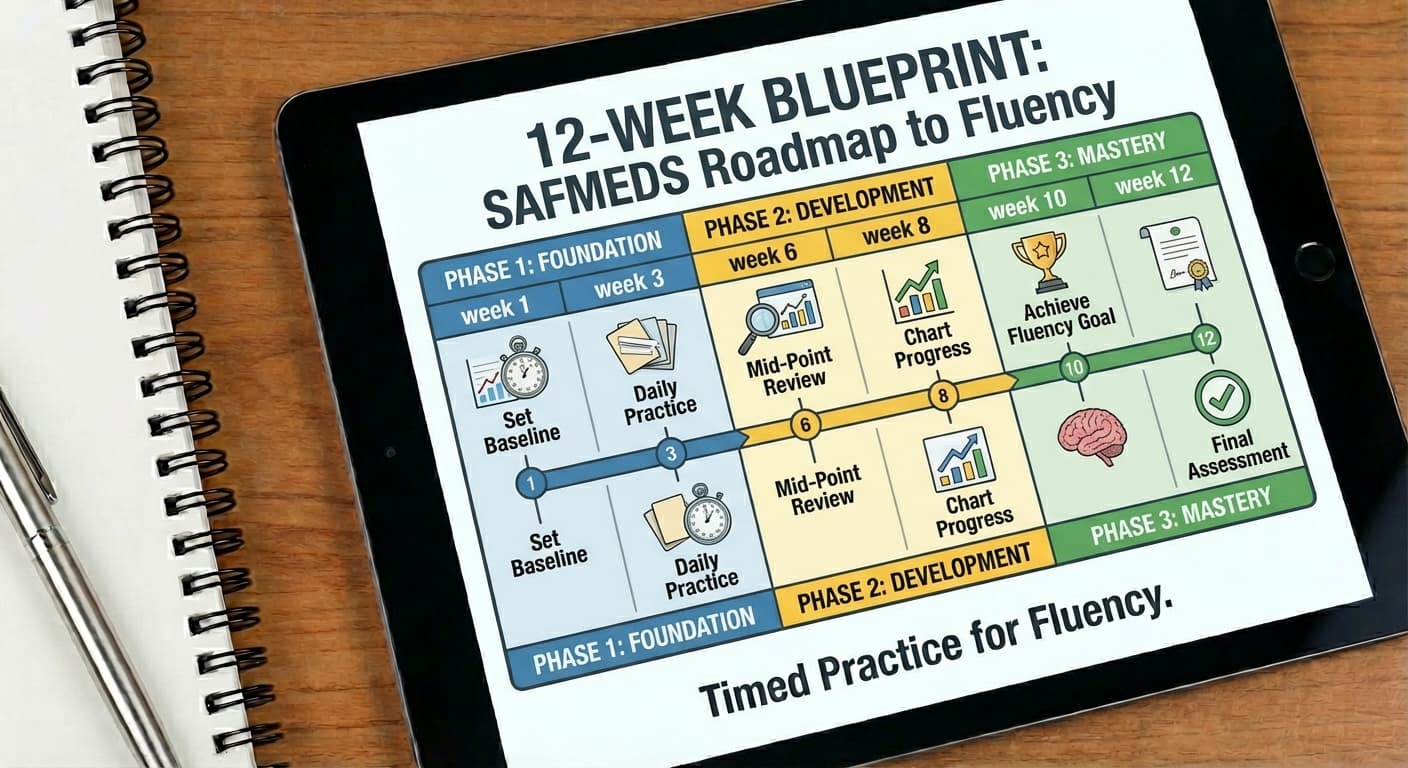
This comprehensive 12-week study blueprint combines SAFMEDS fluency-building methods with strategic exam preparation techniques. Whether you're taking the exam for the first time or preparing for a retake, this guide provides a structured approach to preparation.
By the end of this guide, you'll have:
- A week-by-week study schedule covering all Task List content areas
- Specific fluency aims for each content domain
- Strategies for tackling different question types
- A peak performance plan for exam week
- Troubleshooting tips when progress stalls
Why Traditional Exam Prep Falls Short
Let's be honest about why so many well-prepared candidates fail the BCBA exam.
The Knowledge vs. Fluency Gap
Most test prep focuses on *teaching* content. Courses walk through the Task List, explain concepts, and provide practice questions. This builds knowledge—but knowledge alone isn't enough.
Consider this scenario: You're 90 minutes into the exam. You've answered 80 questions. Fatigue is setting in. A question appears about stimulus equivalence, and you know you studied this. But under time pressure, with cognitive resources depleted, that knowledge feels just out of reach.
This is the knowledge-fluency gap in action. You *know* the material, but you're not *fluent* with it. And the exam ruthlessly exposes this gap.
Why Fluency Matters for Exam Success
The BCBA exam is designed to assess not just knowledge, but the ability to apply that knowledge efficiently under time constraints. Candidates who can recall terminology and concepts quickly have more cognitive resources available for analyzing complex scenarios and selecting the best answers.
Building fluency through systematic practice may help address this challenge.
The 12-Week Blueprint Overview
This study plan is designed for candidates who have completed their coursework and have approximately 3-4 hours of daily study time available. If you have more or less time, adjust the schedule proportionally.
The Three Phases
| Phase | Weeks | Focus | Daily Time |
|---|---|---|---|
| Foundation | 1-4 | Building fluency in core terminology and concepts | 3-4 hours |
| Integration | 5-8 | Connecting concepts and practicing application | 3-4 hours |
| Peak Performance | 9-12 | Full-length practice and strategic refinement | 4+ hours |
The Daily Structure
Each study day follows a consistent pattern:
```
Morning (90 min):
- SAFMEDS timings: 4-6 one-minute sprints per content area
- Review corrects and errors from previous day
- Charting and progress analysis
Midday (60-90 min):
- Content review: Reading, videos, or coursework
- Note-taking and card creation
- Concept mapping
Afternoon/Evening (60-90 min):
- Practice questions: 25-50 per session
- Question analysis: Understanding why answers are correct
- Error pattern identification
```
Phase 1: Foundation (Weeks 1-4)
The first four weeks establish fluent recall of fundamental ABA terminology and concepts. Without this foundation, higher-order application is impossible.
Week 1: Measurement and Data Display
Content Focus:
- Continuous vs. discontinuous measurement
- Rate, frequency, duration, latency, IRT
- Percentage, trials to criterion
- Visual analysis fundamentals
- Line graphs, bar graphs, cumulative records
SAFMEDS Targets:
| Card Set | Starting Aim | End-of-Week Aim |
|---|---|---|
| Measurement terms (40 cards) | 8 correct/min | 13 correct/min |
| Data display terms (25 cards) | 6 correct/min | 11 correct/min |
Daily Schedule:
- Day 1-2: Introduction and initial timings
- Day 3-4: Building speed, addressing errors
- Day 5-6: Pushing toward aims
- Day 7: Review and consolidation
Practice Question Focus:
- Questions asking you to identify appropriate measurement methods
- Scenarios requiring data interpretation
- Graph analysis questions
Week 2: Experimental Design
Content Focus:
- Single-subject design fundamentals
- Reversal/withdrawal designs
- Multiple baseline designs
- Alternating treatments design
- Changing criterion design
- Internal and external validity
SAFMEDS Targets:
| Card Set | Starting Aim | End-of-Week Aim |
|---|---|---|
| Design terminology (35 cards) | 7 correct/min | 12 correct/min |
| Validity concepts (20 cards) | 6 correct/min | 11 correct/min |
Practice Question Focus:
- Design identification scenarios
- Threats to validity questions
- When to use which design
Week 3: Fundamental Concepts
Content Focus:
- Respondent conditioning
- Operant conditioning
- Reinforcement (positive/negative)
- Punishment (positive/negative)
- Extinction
- Stimulus control basics
SAFMEDS Targets:
| Card Set | Starting Aim | End-of-Week Aim |
|---|---|---|
| Basic principles (45 cards) | 8 correct/min | 14 correct/min |
| Stimulus control (30 cards) | 7 correct/min | 13 correct/min |
Practice Question Focus:
- Identifying contingencies in scenarios
- Distinguishing positive from negative procedures
- Predicting behavioral effects
Week 4: Advanced Concepts
Content Focus:
- Schedules of reinforcement
- Verbal behavior (Skinner's analysis)
- Rule-governed vs. contingency-shaped behavior
- Motivating operations
- Stimulus equivalence
SAFMEDS Targets:
| Card Set | Starting Aim | End-of-Week Aim |
|---|---|---|
| Schedules (25 cards) | 6 correct/min | 11 correct/min |
| Verbal operants (35 cards) | 7 correct/min | 13 correct/min |
| MOs and equivalence (30 cards) | 6 correct/min | 12 correct/min |
Phase 2: Integration (Weeks 5-8)
With foundational fluency established, Phase 2 connects concepts and builds application skills. This is where exam performance is truly developed.
Week 5: Assessment and Interpretation
Content Focus:
- Functional behavior assessment
- Indirect, direct, and experimental methods
- Identifying functions of behavior
- Preference assessments
- Skill assessments
SAFMEDS Targets:
Maintain Week 1-4 fluency (brief daily review) while adding:
| Card Set | Starting Aim | End-of-Week Aim |
|---|---|---|
| Assessment methods (40 cards) | 7 correct/min | 13 correct/min |
| Function identification (25 cards) | 6 correct/min | 11 correct/min |
Integration Activities:
- Case study analysis: Given assessment data, identify likely functions
- Method selection: Which assessment for which situation?
Week 6: Behavior Change Procedures
Content Focus:
- Reinforcement-based interventions
- Differential reinforcement procedures
- Antecedent interventions
- Extinction procedures
- Punishment considerations
- Crisis intervention
SAFMEDS Targets:
| Card Set | Starting Aim | End-of-Week Aim |
|---|---|---|
| Intervention procedures (50 cards) | 8 correct/min | 15 correct/min |
| Differential reinforcement (25 cards) | 6 correct/min | 12 correct/min |
Integration Activities:
- Matching functions to interventions
- Sequencing intervention decisions
- Ethical considerations in procedure selection
Week 7: Skill Acquisition
Content Focus:
- Discrete trial training
- Naturalistic teaching
- Prompting and prompt fading
- Shaping and chaining
- Generalization and maintenance
- Teaching verbal behavior
SAFMEDS Targets:
| Card Set | Starting Aim | End-of-Week Aim |
|---|---|---|
| Teaching procedures (45 cards) | 7 correct/min | 14 correct/min |
| Prompting/fading (25 cards) | 6 correct/min | 12 correct/min |
Integration Activities:
- Designing teaching programs
- Selecting prompt hierarchies
- Planning for generalization
Week 8: Ethics and Professional Conduct
Content Focus:
- BACB Ethics Code for Behavior Analysts
- Client rights and dignity
- Professional boundaries
- Supervision requirements
- Documentation and record-keeping
- Scope of competence
SAFMEDS Targets:
| Card Set | Starting Aim | End-of-Week Aim |
|---|---|---|
| Ethics code sections (40 cards) | 7 correct/min | 13 correct/min |
| Professional standards (30 cards) | 6 correct/min | 12 correct/min |
Integration Activities:
- Ethical dilemma analysis
- Applying code sections to scenarios
- Identifying supervision requirements
Phase 3: Peak Performance (Weeks 9-12)
The final phase integrates everything through full-length practice exams and strategic refinement. Your fluency foundation now supports high-level application.
Week 9: Full Integration and First Mock Exam
Activities:
- Maintain all SAFMEDS fluency (abbreviated sessions)
- Complete first full-length (185-question) mock exam under timed conditions
- Detailed error analysis: Categorize misses by content area and question type
- Identify weak areas for targeted review
Mock Exam Protocol:
- Simulate real conditions: 4 hours, minimal breaks
- Track time per section
- Mark uncertain questions for review
- Complete full exam before checking answers
- Score and analyze errors by category
Week 10: Targeted Remediation
Based on Week 9 mock exam results:
- Increase SAFMEDS frequency for weak content areas
- Add targeted practice questions for problem question types
- Review course materials for conceptually weak areas
- Create new cards for concepts that caused errors
Error Pattern Analysis:
| Error Type | Likely Cause | Remediation |
|---|---|---|
| Terminology confusion | Insufficient fluency | More SAFMEDS timings |
| Application errors | Conceptual gaps | Review and mapping |
| Mis-reading questions | Test-taking skills | Question analysis practice |
| Time pressure errors | Need more automaticity | Speed-focused practice |
Week 11: Second Mock Exam and Refinement
Activities:
- Second full-length mock exam
- Compare results to Week 9: Improvement in targeted areas?
- Fine-tune remaining weak points
- Practice exam-day strategies
Test-Taking Strategies to Practice:
- First pass: Answer all questions you know immediately
- Second pass: Return to marked questions with fresh perspective
- Elimination: Use partial knowledge to improve odds
- Time checkpoints: Where you should be at 1 hour, 2 hours, 3 hours
Week 12: Peak Performance Week
Days 1-4: Light Maintenance
- Brief SAFMEDS sessions (maintenance, not building)
- Light content review—no new learning
- Short practice question sessions (quality over quantity)
- Focus on rest and confidence
Days 5-6: Pre-Exam Preparation
- Organize exam logistics (ID, confirmation, location)
- Light review of high-frequency content only
- Visualization and mental rehearsal
- Early bedtimes
Day 7 (Exam Eve):
- No studying after noon
- Light physical activity
- Prepare exam materials
- Early dinner, relaxation, early sleep
Fluency Aims: Your Performance Targets
Throughout this program, work toward these fluency aims (correct responses per minute):
Foundational Terms
| Content Area | Minimum Aim | Mastery Aim |
|---|---|---|
| Measurement | 11 correct/min | 17+ correct/min |
| Experimental design | 10 correct/min | 15+ correct/min |
| Basic principles | 13 correct/min | 18+ correct/min |
| Stimulus control | 11 correct/min | 17+ correct/min |
Applied Content
| Content Area | Minimum Aim | Mastery Aim |
|---|---|---|
| Assessment | 11 correct/min | 16+ correct/min |
| Interventions | 12 correct/min | 17+ correct/min |
| Skill acquisition | 11 correct/min | 16+ correct/min |
| Ethics | 10 correct/min | 15+ correct/min |
Troubleshooting Common Problems
Problem: Progress Has Stalled
Symptoms: Fluency hasn't improved for 3+ days despite practice
Solutions:
- Slice back: Divide the deck into smaller sets and master each
- Analyze errors: Are certain cards consistently wrong? Focus there
- Add context: Create cards that present terms in different ways
- Rest: Sometimes plateaus indicate need for consolidation time
Problem: High Errors During Timings
Symptoms: Pushing speed causes accuracy to drop below 80%
Solutions:
- Slow down: Accuracy must stay above 80% during building
- Review errors: Ensure you truly understand missed terms
- Use untimed practice: Build accuracy before speed
- Check card quality: Are definitions clear and memorable?
Problem: Can't Finish Practice Exams in Time
Symptoms: Running out of time during mock exams
Solutions:
- Build more fluency: If basic recall is slow, application is slower
- Practice pacing: Set time checkpoints during practice exams
- First-pass strategy: Answer certain questions first, return to uncertain
- Identify time sinks: Which question types take longest? Target those
Problem: Know Content But Miss Application Questions
Symptoms: Strong SAFMEDS performance but weak on scenario questions
Solutions:
- Add application cards: Create cards that require identifying concepts in examples
- Practice question analysis: Study why correct answers are correct
- Map concepts: Create visual connections between related terms
- Do more case studies: Practice applying concepts to realistic scenarios
The TAFMEDS Advantage
While this blueprint can be executed with any SAFMEDS implementation, TAFMEDS provides specific advantages for BCBA exam preparation:
Automated Progress Tracking
On the Student and Professional plans, TAFMEDS charts every timing on a Standard Celeration Chart, with celeration lines and your aim line, so you can see how quickly you are progressing toward your aim. No manual charting required.
Aims That Fit the Deck
Practice aims are set per deck from the length of its answers, because longer answers take longer to type. They start at no more than 15 correct per minute and rise automatically once you hold an aim for three charted days. See Setting Fluency Aims for how that works.
Pre-Built BCBA Content Decks
Access curated card sets aligned with the BACB 6th Edition Test Content Outline, organized by content area and ready for immediate practice.
Error Analysis
Automatically track which cards cause the most errors, identifying exactly where to focus your remediation efforts.
Session Recovery
If life interrupts a practice session, TAFMEDS saves your progress and allows seamless continuation.
Final Thoughts: The Confidence of Fluency
There's a specific feeling that comes from true fluency—a quiet confidence that you don't just know the material but *own* it. When you sit down for the BCBA exam with fluent recall of every Task List term, something shifts. Questions that would have caused panic become straightforward applications of knowledge that flows automatically.
This blueprint isn't about studying harder. It's about studying smarter—building the kind of automatic, pressure-resistant knowledge that distinguishes those who pass from those who don't.
Your journey to BCBA certification represents years of dedication to the field of behavior analysis. Give yourself the best possible chance of success by building the fluency that transforms knowledge into competence.
The exam tests whether you're ready to call yourself a Board Certified Behavior Analyst. Make sure your preparation matches the significance of that credential.
References
- Behavior Analyst Certification Board. (2022). *BCBA test content outline (6th ed.)*. Littleton, CO: Author.
- Binder, C. (1996). Behavioral fluency: Evolution of a new paradigm. *The Behavior Analyst, 19*(2), 163-197.
- Johnson, K. R., & Street, E. M. (2004). The Morningside Model of Generative Instruction: What it means to leave no child behind. Concord, MA: Cambridge Center for Behavioral Studies.
- Kubina, R. M., & Yurich, K. K. L. (2012). *The precision teaching book*. Lemont, PA: Greatness Achieved.
- Lindsley, O. R. (1992). Precision teaching: Discoveries and effects. *Journal of Applied Behavior Analysis, 25*(1), 51-57.
- Behavior Analyst Certification Board. (2024). *BCBA & BCaBA Examination Pass Rates*. Retrieved from bacb.com.