The Board Certified Assistant Behavior Analyst (BCaBA) certification represents a significant milestone in your behavior analysis career. It validates your competence to practice under BCBA supervision and opens doors to meaningful clinical work.
But the BCaBA exam isn't just a test of what you know—it's a test of how fluently you can apply that knowledge under timed conditions. This guide provides everything you need to prepare strategically, study effectively, and walk into your exam with confidence.
Understanding the BCaBA Credential
What Is a BCaBA?
The Board Certified Assistant Behavior Analyst is a mid-level certification in applied behavior analysis. BCaBAs work under the supervision of BCBAs to:
- Implement behavior-analytic interventions
- Conduct assessments under supervision
- Collect and analyze data
- Train and support implementation staff
- Contribute to treatment planning
The BCaBA role bridges the gap between RBTs (who implement protocols) and BCBAs (who design and oversee programs). It's an ideal credential for those who want more clinical responsibility than an RBT but aren't yet ready for—or don't need—full BCBA certification.
BCaBA vs. BCBA: Key Differences
| Aspect | BCaBA | BCBA |
|---|---|---|
| Education requirement | Bachelor's degree | Master's degree |
| Coursework hours | 225 verified course hours | 315 verified course hours |
| Supervision hours | 1,000-1,500 hours | 1,500-2,000 hours |
| Independent practice | Must work under BCBA supervision | Can practice independently |
| Scope of practice | Implementation-focused | Design and oversight |
| Exam questions | 160 questions | 185 questions |
BCaBA Exam Structure and Format
Exam Basics
- Total questions: 160 multiple-choice items
- Scored questions: 140 (20 are unscored pilot questions)
- Time limit: 4 hours
- Passing score: Determined by modified Angoff method (not a fixed percentage)
- Format: Computer-based testing at Pearson VUE centers
Exam Content Areas
The BCaBA exam is based on the BACB's BCaBA Test Content Outline (6th ed.), organized into these content areas:
| Section | Content Area |
|---|---|
| A | Behaviorism and Philosophical Foundations |
| B | Concepts and Principles |
| C | Measurement, Data Display, and Interpretation |
| D | Experimental Design |
| E | Ethical and Professional Issues |
| F | Behavior Assessment |
| G | Behavior-Change Procedures |
| H | Selecting and Implementing Interventions |
| I | Personnel Supervision and Management |
The outline, including how many questions come from each content area, is published by the BACB. Check the current BCaBA Test Content Outline on the BACB website before you plan your study time, and give the most hours to the content areas with the most questions.
Question Types
BCaBA exam questions come in several formats:
- Direct recall: "What is the definition of negative reinforcement?"
- Application scenarios: "Given this situation, which procedure would be most appropriate?"
- Best answer: All options may be partially correct; choose the BEST option
- Ethics-based: "What should the BCaBA do in this scenario?"
The exam emphasizes application over memorization. You'll need fluent knowledge of concepts to quickly analyze scenarios under time pressure.
Eligibility Requirements
Education Requirements
- Degree: Bachelor's degree or higher in any field (behavior analysis degree preferred but not required)
- Coursework: 225 hours of graduate-level instruction in behavior analysis
- Must include content on all Task List areas
Experience Requirements
You need supervised fieldwork in one of two pathways:
| Pathway | Hours Required | Supervision Ratio |
|---|---|---|
| Supervised Fieldwork | 1,000 hours | 5% supervision minimum |
| Concentrated Supervised Fieldwork | 1,500 hours | 10% supervision minimum |
All supervision must be provided by a BCBA, BCBA-D, or authorized BCaBA supervisor.
Application Process
- Create a BACB account
- Submit academic documentation
- Submit experience documentation
- Pay application fee
- Receive eligibility notification
- Schedule exam at Pearson VUE
Pro Tip
Building Your Study Plan
Step 1: Assess Your Starting Point
Before diving into study, evaluate your current knowledge:
Self-assessment questions:
- Which Task List sections do you feel confident about?
- Where do you struggle during supervision discussions?
- What concepts come up repeatedly that you can't explain clearly?
- How do you perform on practice questions?
Take a baseline practice test (available from various exam prep providers) to identify specific weak areas.
Step 2: Calculate Your Timeline
| Preparation Level | Recommended Timeline |
|---|---|
| Strong foundation (recent coursework, active practice) | 6-8 weeks |
| Moderate foundation (coursework completed, some practice gap) | 10-12 weeks |
| Weaker foundation (older coursework, minimal practice) | 14-16 weeks |
Step 3: Structure Your Study Schedule
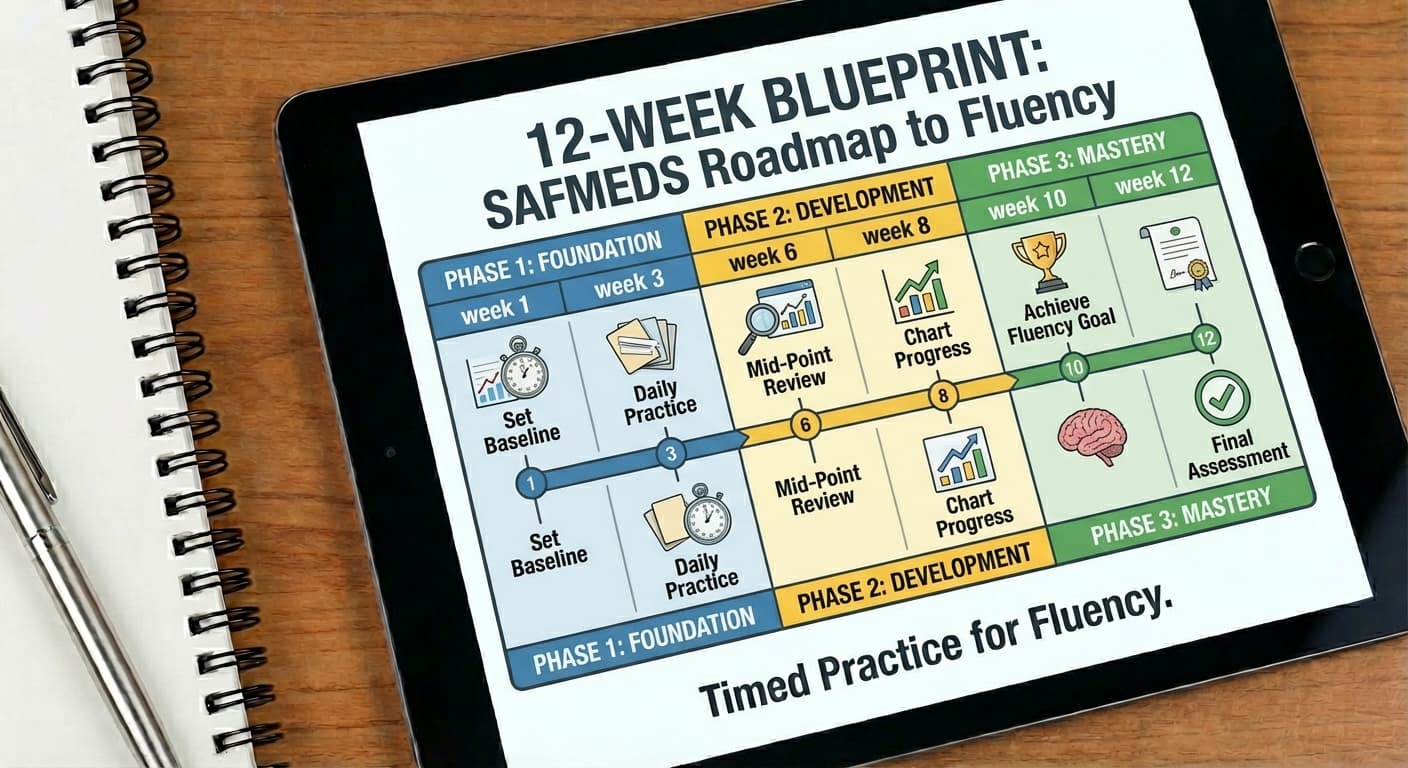
Weekly allocation for 12-week plan:
| Weeks | Focus Area |
|---|---|
| 1-2 | Section A (Philosophy) + Section D (Experimental Design) |
| 3-4 | Section B (Concepts and Principles) |
| 5-6 | Section C (Measurement) + Section G Part 1 |
| 7-8 | Section G Part 2 (Behavior-Change Procedures) |
| 9-10 | Section E (Ethics) + Section F (Assessment) |
| 11-12 | Sections H + I + Full Review |
Adjust the weeks to the question counts in the BACB's published outline: spend longer on the content areas that carry more questions and on the ones you find hardest.
Step 4: Daily Study Sessions
Recommended daily structure:
- SAFMEDS practice (15-20 minutes): Build fluency on key terminology
- Content review (30-45 minutes): Read, take notes, create study materials
- Practice questions (20-30 minutes): Apply knowledge to scenarios
- Review mistakes (10-15 minutes): Analyze errors and fill gaps
Total: 75-110 minutes per day, 5-6 days per week
Content-Specific Study Strategies
Section A: Philosophical Underpinnings
Key concepts:
- Determinism and the philosophical foundations of behavior analysis
- Dimensions of ABA (applied, behavioral, analytic, technological, conceptually systematic, effective, generality)
- Science vs. pseudoscience
- Parsimonious explanations
Study approach:
- Memorize the 7 dimensions of ABA and be able to identify examples
- Understand what makes explanations parsimonioustable
- Know how to identify pseudoscientific claims
Section B: Concepts and Principles
Key concepts:
- Respondent and operant conditioning
- Reinforcement and punishment (positive and negative)
- Extinction and schedule effects
- Stimulus control, discrimination, and generalization
- Motivating operations
- Verbal behavior
Study approach:
- Create SAFMEDS cards for all terminology
- Practice identifying concepts in novel scenarios
- Master the distinction between MOs and SDs
Section C: Measurement and Data
Key concepts:
- Operational definitions
- Measurement procedures (frequency, duration, latency, IRT, etc.)
- Data collection systems (continuous, discontinuous)
- Graphing conventions
- Data interpretation
Study approach:
- Practice writing operational definitions
- Know when to use each measurement procedure
- Be able to interpret graphs and identify trends
Section D: Experimental Design
Key concepts:
- Within-subject designs (reversal, multiple baseline, alternating treatments, changing criterion)
- Threats to validity
- Experimental control
Study approach:
- Memorize characteristics of each design
- Practice identifying appropriate designs for given scenarios
- Understand internal and external validity
Section E: Ethics
Key concepts:
- Ethics Code for Behavior Analysts
- Professional boundaries
- Informed consent
- Confidentiality
- Competence and supervision
- Multiple relationships
Study approach:
- Read the entire Ethics Code multiple times
- Create cards for each ethics standard
- Practice ethical decision-making scenarios
- Know the order of priorities (client welfare, professional responsibilities, colleagues)
Section F: Behavior Assessment
Key concepts:
- Indirect assessment methods (interviews, rating scales)
- Direct assessment methods (ABC recording, functional analysis)
- Preference assessments
- Skill assessments
- Functional behavior assessment
- Functional analysis methodology
Study approach:
- Know the difference between descriptive and experimental analysis
- Master preference assessment methods (MSWO, paired stimulus, free operant)
- Understand when each assessment method is appropriate
Section G: Behavior-Change Procedures
Key concepts:
- Reinforcement-based procedures
- Extinction procedures
- Differential reinforcement (DRA, DRI, DRO, DRL, DRH)
- Antecedent interventions
- Prompting and prompt fading
- Shaping and chaining
- Skills training procedures
- Generalization and maintenance
Study approach:
- Expect many scenarios that ask you to identify or choose a procedure
- Create extensive SAFMEDS coverage
- Practice identifying procedures in scenarios
- Know the advantages, disadvantages, and considerations for each procedure
Section H: Selecting and Implementing Interventions
Key concepts:
- Evidence-based practice
- Treatment selection criteria
- Social validity
- Implementation fidelity
- Treatment integrity
Study approach:
- Focus on decision-making frameworks
- Understand what makes interventions evidence-based
- Know how to evaluate treatment effectiveness
Section I: Personnel Supervision and Management
Key concepts:
- Supervision requirements and responsibilities
- Training methods
- Performance feedback
- Organizational behavior management
Study approach:
- Know BCaBA supervision requirements
- Understand effective training and feedback methods
- Remember that BCaBAs supervise RBTs under BCBA guidance
Building Fluency with SAFMEDS
Why Fluency Matters for the BCaBA Exam
The BCaBA exam gives you 4 hours for 160 questions—that's an average of 1.5 minutes per question. You don't have time to slowly recall definitions or puzzle through basic concepts.
Fluency means:
- Instant recall of terminology and definitions
- Automatic recognition of concepts in scenarios
- Fast processing that leaves time for complex analysis
- Stress-resistant performance that doesn't break down under exam pressure
Creating Your BCaBA SAFMEDS Decks
Organize your cards by Task List section:
Aims below are typed-channel (see/type) targets, the channel you practice in with TAFMEDS — spoken-card aims run 2-3x higher, and the app derives each deck's exact entry aim from its own cards:
| Deck | Card Count | Aim (typed) |
|---|---|---|
| Section A: Philosophy | 25-30 | 14-15/min |
| Section B: Concepts | 60-80 | 12-15/min |
| Section C: Measurement | 40-50 | 12-15/min |
| Section D: Experimental Design | 20-25 | 14-15/min |
| Section E: Ethics | 50-60 | 10-13/min |
| Section F: Assessment | 45-55 | 12-15/min |
| Section G: Procedures | 80-100 | 10-13/min |
| Section H: Intervention Selection | 25-30 | 12-15/min |
| Section I: Supervision | 20-25 | 14-15/min |
Sample SAFMEDS Cards by Section
Section B - Concepts:
- Front: "Define: Motivating operation"
- Back: "An environmental variable that alters the value of a consequence and the frequency of behavior related to that consequence"
Section E - Ethics:
- Front: "Ethics Code: What should you do if you suspect a colleague of unethical behavior?"
- Back: "First attempt to resolve informally; if unsuccessful, report to relevant authority (employer, BACB, regulatory body)"
Section F - Assessment:
- Front: "What are the 4 conditions in a standard functional analysis?"
- Back: "Attention, Demand (escape), Tangible (access), Alone (automatic)"
Section G - Procedures:
- Front: "Define: DRO"
- Back: "Differential Reinforcement of Other behavior—reinforcement delivered for the absence of target behavior during a specified interval"
Practice Testing Strategy
When to Start Practice Tests
| Phase | Timing | Purpose |
|---|---|---|
| Baseline | Week 1-2 | Identify starting point and weak areas |
| Mid-point | Week 6-7 | Check progress and adjust study focus |
| Final prep | Week 10-12 | Simulate exam conditions, build stamina |
How to Use Practice Tests Effectively
- Simulate exam conditions: 4 hours, no breaks, no resources
- Review every question: Even ones you got right—understand why
- Track error patterns: Which sections or question types cause problems?
- Focus review time: Spend most review time on missed concepts
Interpreting Practice Scores
| Practice Score | Interpretation | Recommendation |
|---|---|---|
| Below 60% | Significant knowledge gaps | Extend timeline, increase study intensity |
| 60-70% | Foundational knowledge present | Focus on fluency and application |
| 70-80% | Solid preparation | Fine-tune weak areas, maintain fluency |
| Above 80% | Strong readiness | Maintain practice, avoid overconfidence |
The Week Before Your Exam
Days 7-4: Light Review
- Continue SAFMEDS practice at reduced intensity
- Review highlighted notes and weak areas
- Take one more practice test if needed
- Avoid new material—focus on reinforcing what you know
Days 3-2: Prepare Logistics
- Confirm exam appointment
- Verify testing center location and parking
- Prepare required ID documents
- Plan your pre-exam routine (sleep, breakfast, travel)
Day 1: Rest and Prepare
- Light SAFMEDS practice only (15-20 minutes)
- No intensive studying
- Prepare everything you need for exam day
- Go to bed at your normal time
Exam Day
- Eat a normal breakfast
- Arrive 30 minutes early
- Use waiting time for brief SAFMEDS review
- Trust your preparation
Exam-Day Strategies
Time Management
- First pass: Answer questions you know immediately (don't overthink)
- Mark for review: Flag questions that require more thought
- Second pass: Return to flagged questions with remaining time
- Never leave blanks: There's no penalty for guessing
Pacing guide:
- At 1 hour: Should be around question 40
- At 2 hours: Should be around question 80
- At 3 hours: Should be around question 120
- Final hour: Complete remaining questions, review flagged items
Reading Questions Carefully
Before reading options:
- Read the question stem completely
- Try to answer in your mind before looking at options
- Read all options before selecting
Red flags in answer choices:
- Absolute words (always, never, only) are often wrong
- Answers that match common misconceptions
- Options that are partially correct but incomplete
Handling Difficult Questions
When stuck:
- Eliminate clearly wrong options
- Look for the answer that BEST addresses the question
- Consider what the question is testing
- If still stuck, make your best guess and move on
After the Exam
Receiving Results
- Results are typically available within 3-5 business days
- Check your BACB account for score report
- Passing candidates receive certification notification
If You Pass
- Complete any remaining certification requirements
- Download and display your certificate
- Update professional profiles
- Begin accruing continuing education credits
If You Don't Pass
- Review your score report for section-specific feedback
- Identify areas needing additional study
- You can retest after 30 days (up to 8 attempts per year)
- Consider whether additional coursework or supervision would help
Persistence Pays
Recommended Resources
Primary Study Materials
- Cooper, Heron, & Heward: *Applied Behavior Analysis* (the comprehensive ABA textbook)
- BACB 6th Edition Test Content Outline: Official content outline for the exam
- Ethics Code for Behavior Analysts: Required reading for ethics content
Supplementary Resources
- Pass the Big ABA Exam: Study guides and practice questions
- ABA Study Group: Community support and discussion
- BDS Modules: Comprehensive online study materials
- TAFMEDS: Fluency-based study for terminology and definitions
Practice Test Sources
Multiple organizations offer BCaBA practice exams. Use several to expose yourself to different question styles.
Conclusion
Passing the BCaBA exam requires more than knowledge—it requires fluent, applicable understanding that performs under timed, high-stakes conditions.
Your path to success:
- Understand the exam: Know the structure, content distribution, and question types
- Build your plan: Create a realistic timeline with daily study sessions
- Prioritize strategically: Weight your study time by the question counts in the BACB's published outline
- Build fluency: Use SAFMEDS for terminology and definitions
- Practice application: Work through scenarios and practice questions
- Simulate conditions: Take full-length practice tests under exam conditions
- Trust your preparation: On exam day, execute what you've practiced
The BCaBA credential validates your competence and opens professional opportunities. The preparation process itself deepens your expertise. Either way, the investment in studying makes you a better behavior analyst.
What section will you tackle first?
Start building fluency for your BCaBA exam with TAFMEDS—master terminology now so you can focus on application during the exam.
Related Articles
- BCBA Exam Study Blueprint: 12-Week Guide - Planning strategies that also apply to BCaBA prep
- RBT Exam Preparation: Complete Guide - Foundation concepts to review
- What is SAFMEDS? The Complete Guide - Master the study method
References
- Behavior Analyst Certification Board. (2022). *Board Certified Assistant Behavior Analyst Handbook*. Littleton, CO: Author.
- Behavior Analyst Certification Board. (2022). *Ethics Code for Behavior Analysts*. Littleton, CO: Author.
- Cooper, J. O., Heron, T. E., & Heward, W. L. (2020). *Applied Behavior Analysis* (3rd ed.). Hoboken, NJ: Pearson.
- Behavior Analyst Certification Board. (2022). *BCaBA test content outline (6th ed.)*. Littleton, CO: Author.
- Kubina, R. M., & Yurich, K. K. L. (2012). *The Precision Teaching Book*. Lemont, PA: Greatness Achieved.
- Binder, C. (1996). Behavioral fluency: Evolution of a new paradigm. *The Behavior Analyst, 19*(2), 163-197.