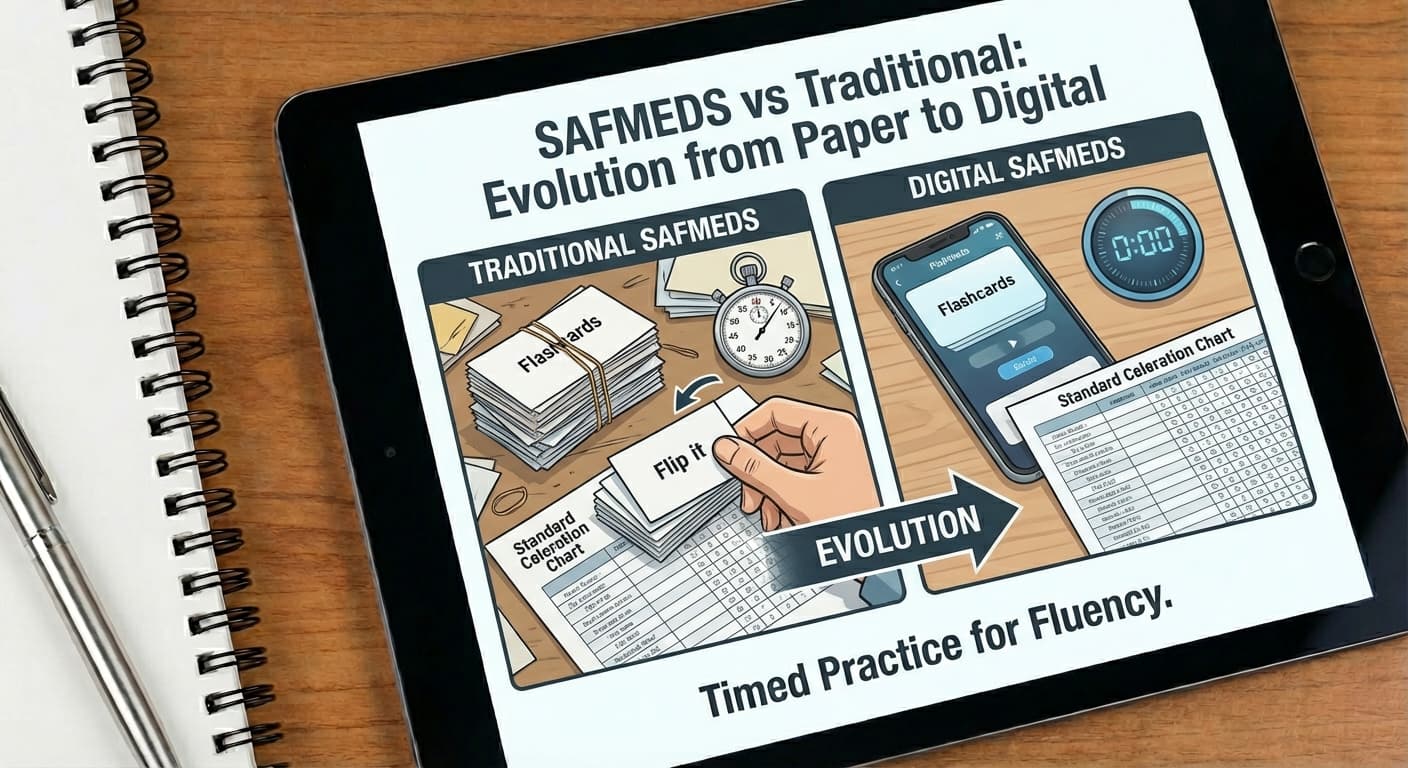
Flashcards have been a study staple for generations. From vocabulary words in elementary school to medical terminology in graduate programs, the basic concept remains unchanged: question on one side, answer on the other, flip and repeat.
But not all flashcard methods are equal. The difference between traditional flashcard review and SAFMEDS (Say All Fast Minute Every Day Shuffled) isn't just procedural—it's fundamental. Research consistently shows that these two approaches produce dramatically different learning outcomes.
This article provides a comprehensive, research-backed comparison of both methods. By the end, you'll understand exactly why SAFMEDS works better and how to make the switch from traditional review to fluency-based practice.
The Core Difference: Recognition vs. Fluency
Before diving into specific comparisons, it's essential to understand the fundamental distinction between what each method builds.
Traditional flashcards build recognition.
You see a term, think about it, flip the card, and confirm whether you were right. The goal is accuracy—can you eventually produce the correct answer?
SAFMEDS builds fluency.
You see a term, respond immediately, track your speed and accuracy, and measure improvement over time. The goal is automatic, fast, accurate responding under time pressure.
This difference might seem subtle, but its implications are profound.
Why This Distinction Matters
Consider how knowledge is actually used:
| Situation | What's Required | Recognition Enough? |
|---|---|---|
| Multiple choice exam | Recognize correct option | Sometimes |
| Short answer exam | Produce answer from memory | No |
| Timed exam | Fast retrieval under pressure | No |
| Clinical application | Instant recall during patient care | No |
| Professional conversation | Fluent use of terminology | No |
Traditional flashcards might prepare you for untimed multiple choice questions. SAFMEDS prepares you for everything else.
Head-to-Head Comparison
Let's examine how these methods differ across key dimensions.
1. Timing
| Aspect | Traditional Flashcards | SAFMEDS |
|---|---|---|
| Time per card | Unlimited, self-paced | Constrained by 60-second timing |
| Session structure | Variable length | Fixed 60-second sprints |
| Speed emphasis | None | Core training target |
| Urgency | Low | High |
Why it matters: Without time pressure, you naturally settle into comfortable, slow responding. This builds deliberate retrieval that requires conscious effort—exactly the type of knowledge that fails under exam stress.
Research by Kubina and Morrison (2000) demonstrated that timed practice produces learning rates 2-4x faster than untimed approaches. The timer isn't just measuring performance; it's *driving* improvement.
2. Measurement
| Aspect | Traditional Flashcards | SAFMEDS |
|---|---|---|
| Primary metric | Percent correct | Count per minute |
| Progress tracking | Subjective feeling | Standard Celeration Chart |
| Ceiling effect | Yes (100% max) | No (speed can always improve) |
| Sensitivity | Low | High |
Why it matters: Percent correct has a ceiling. Once you're at 90-100% accuracy, there's no room to show continued improvement—even though you might still be far from fluent.
Count per minute has no ceiling. Even at 100% accuracy, you can always get faster. This makes it more sensitive to real learning gains and provides continuous feedback throughout the learning process.
3. Card Order
| Aspect | Traditional Flashcards | SAFMEDS |
|---|---|---|
| Shuffling | Optional, often skipped | Required before every timing |
| Order consistency | Often the same sequence | Different every time |
| Position learning | Common problem | Eliminated |
Why it matters: Your brain is exceptionally good at learning sequences. After a few passes through cards in the same order, you start learning *position* rather than content. You remember "the fifth card is reinforcement" rather than actually knowing what reinforcement means.
This positional learning creates false confidence that evaporates on exams, where questions appear in completely unpredictable order.
4. Response Type
| Aspect | Traditional Flashcards | SAFMEDS |
|---|---|---|
| Response mode | Think, then check | Produce, then verify |
| Active recall | Often passive (look at answer) | Always active (say/type first) |
| Self-deception | Easy ("I knew that") | Difficult (data doesn't lie) |
Why it matters: Traditional review makes it easy to flip a card, see the answer, and think "I knew that." But did you? Or did you just recognize it?
SAFMEDS requires you to produce the response *before* seeing the answer. This forces genuine recall rather than recognition, dramatically strengthening memory traces.
5. Practice Frequency
| Aspect | Traditional Flashcards | SAFMEDS |
|---|---|---|
| Typical pattern | Sporadic, before exams | Daily, consistent |
| Session duration | Long, variable | Short, fixed (3-6 minutes) |
| Spacing | Often massed (cramming) | Distributed (daily) |
Why it matters: Memory consolidation requires distributed practice with sleep between sessions. Daily short sessions dramatically outperform weekly long sessions, even with less total study time.
Cepeda et al.'s (2006) meta-analysis of spacing effects found that distributed practice consistently outperforms massed practice by 2-3x for long-term retention.
What the Research Shows
Multiple studies have directly or indirectly compared these approaches. Here's what the evidence reveals.
Fluency Outcomes (RESA)
Carl Binder's research on behavioral fluency (1996) established that true mastery produces four critical outcomes, known as RESA:
| Outcome | Traditional Flashcards | SAFMEDS |
|---|---|---|
| Retention (memory over time) | ~50% after 2 weeks | ~85% after 2 weeks |
| Endurance (sustained performance) | Declines after 30 min | Maintained 4+ hours |
| Stability (performance under distraction) | -20-30% with distractors | Minimal impact |
| Application (transfer to new situations) | Rare | Common |
These outcomes don't emerge from accuracy alone—they require the combination of speed and accuracy that defines fluency. Traditional flashcards build accuracy; SAFMEDS builds fluency.
Learning Rate Comparison
Precision Teaching research spanning 50+ years has consistently found that frequency-based (timed) practice produces faster learning:
| Metric | Traditional | SAFMEDS | Advantage |
|---|---|---|---|
| Weekly improvement rate | x1.1-1.2 | x1.5-2.0 | 50-100% faster |
| Time to fluency aim | 12+ weeks | 4-6 weeks | 50% less time |
| Retention after training | Variable | Consistent | More predictable |
Exam Performance
While direct controlled studies comparing SAFMEDS to traditional flashcards on certification exams are limited, related research strongly suggests advantages:
- Students using fluency-based methods show 20-30% higher scores on timed assessments (Johnson & Street, 2004)
- Timed practice reduces test anxiety by making pressure feel familiar (Binder, 1996)
- Fluent responders complete exams faster, leaving time for review
Real-World Scenarios
Let's examine how these differences play out in practice.
Scenario 1: Graduate Student Preparing for BCBA Exam
Traditional Approach (Emma)
- Creates 500 flashcards from task list
- Reviews 50-100 cards per session, 3x per week
- Sessions take 45-60 minutes each
- Feels confident after recognizing most terms
- On exam day: struggles with time pressure, second-guesses answers
SAFMEDS Approach (Marcus)
- Uses same 500 terms in TAFMEDS
- Completes 6 one-minute timings daily (6 minutes active practice)
- Tracks count per minute on Standard Celeration Chart
- Knows exactly which terms need more work based on data
- On exam day: responds automatically, finishes with time to spare
Same content. Same goal. Dramatically different outcomes.
Scenario 2: Medical Student Learning Pharmacology
Traditional Approach
- Reviews drug cards the night before each exam
- Long sessions (2-3 hours) of untimed review
- Sorts "known" cards out of the deck
- Cramming creates short-term recognition
SAFMEDS Approach
- Daily 10-minute practice sessions across the semester
- Timed practice builds automatic recall
- All cards stay in rotation (no "known" pile)
- Distributed practice creates durable memory
The traditional student might pass immediate exams but struggle to recall drugs months later during clinical rotations. The SAFMEDS student builds knowledge that transfers to practice.
Common Objections to Switching
Students accustomed to traditional flashcards often resist switching. Here are the most common objections—and why they don't hold up.
"I don't have time for daily practice"
SAFMEDS actually requires *less* total time than traditional review:
| Method | Time per Session | Sessions per Week | Weekly Total |
|---|---|---|---|
| Traditional | 45-60 minutes | 2-3 | 90-180 minutes |
| SAFMEDS | 6-10 minutes | 7 | 42-70 minutes |
Daily short sessions beat sporadic long sessions—and take less time overall.
"I need to understand, not just respond fast"
Speed and understanding aren't opposites. Fluent foundational knowledge actually enables deeper understanding by freeing cognitive resources for higher-order thinking.
Students who struggle with application often have a fluency problem, not a comprehension problem. They can't apply concepts because basic recall is consuming all their mental bandwidth.
"Traditional flashcards have always worked for me"
"Worked" is relative. Did you:
- Retain information months after the exam?
- Perform well under time pressure?
- Apply knowledge in novel situations?
- Study efficiently (good results per hour invested)?
Traditional flashcards might produce passing grades, but they often fail on deeper measures of learning effectiveness.
"Timed practice stresses me out"
Some initial discomfort is normal—and productive. It's the "optimal challenge" that drives improvement.
Counterintuitively, students who practice under time pressure report *less* anxiety on actual timed exams. The pressure feels familiar rather than threatening.
Making the Switch: A Practical Guide
Ready to move from traditional flashcards to SAFMEDS? Here's how to transition effectively.
Week 1: Learn the Protocol
- Convert your existing cards to a SAFMEDS-compatible format (or use TAFMEDS pre-built decks)
- Practice the 60-second timing protocol
- Learn to count corrects and errors
- Establish your baseline count per minute
Week 2: Build the Habit
- Set a consistent daily practice time
- Complete 3-6 timings per session
- Record your data after each session
- Resist the urge to revert to untimed review
Weeks 3-4: Trust the Process
- Watch your celeration line on the chart
- Push speed even when errors increase temporarily
- Shuffle thoroughly before every timing
- Celebrate improvement in count per minute
Week 5+: Refine and Expand
- Adjust based on your data
- Add new content as fluency develops
- Set specific fluency aims: 15 to 25 correct per minute when typing, as TAFMEDS practice is, and higher when saying answers aloud
- Apply the method to new subjects
Pro Tip
Why TAFMEDS Makes the Difference Easy
TAFMEDS (Type All Fast Minute Every Day Shuffled) implements every SAFMEDS advantage automatically:
| Feature | Traditional Cards | TAFMEDS |
|---|---|---|
| Timing | Manual (often skipped) | Automatic, precise |
| Shuffling | Manual (often inadequate) | True randomization |
| Counting | Manual (error-prone) | Instant, accurate |
| Charting | Manual (often skipped) | Real-time Standard Celeration Chart |
| Analysis | None | Celeration calculation, recommendations |
The automation removes every point of friction that causes students to drift back to traditional methods. You just practice—the system handles everything else.
The Bottom Line
Traditional flashcards and SAFMEDS both use cards with questions and answers. That's where the similarity ends.
| Dimension | Traditional | SAFMEDS | Winner |
|---|---|---|---|
| Builds fluency | No | Yes | SAFMEDS |
| Time efficient | No | Yes | SAFMEDS |
| Data-driven | No | Yes | SAFMEDS |
| Prevents position learning | No | Yes | SAFMEDS |
| Produces RESA outcomes | Rarely | Consistently | SAFMEDS |
| Transfers to timed exams | Poorly | Well | SAFMEDS |
The research is clear: if you're going to invest time studying with flashcards, the SAFMEDS method produces dramatically superior outcomes. The question isn't whether to use flashcards—it's whether to use them effectively.
Start practicing the right way with TAFMEDS and experience the difference fluency-based learning makes.
Related Articles
- What is SAFMEDS? The Complete Guide - Master the methodology
- Why 60 Seconds Changes Everything - The science of timed practice
- 5 Common SAFMEDS Mistakes - Avoid the pitfalls
References
- Binder, C. (1996). Behavioral fluency: Evolution of a new paradigm. *The Behavior Analyst, 19*(2), 163-197.
- Cepeda, N. J., Pashler, H., Vul, E., Wixted, J. T., & Rohrer, D. (2006). Distributed practice in verbal recall tasks: A review and quantitative synthesis. *Psychological Bulletin, 132*(3), 354-380.
- Johnson, K. R., & Street, E. M. (2004). The Morningside Model of Generative Instruction: What it means to leave no child behind. *Journal of Precision Teaching and Celeration, 20*(2), 1-24.
- Kubina, R. M., & Morrison, R. S. (2000). Fluency in education. *Behavior and Social Issues, 10*, 83-99.
- Roediger, H. L., & Karpicke, J. D. (2006). Test-enhanced learning: Taking memory tests improves long-term retention. *Psychological Science, 17*(3), 249-255.