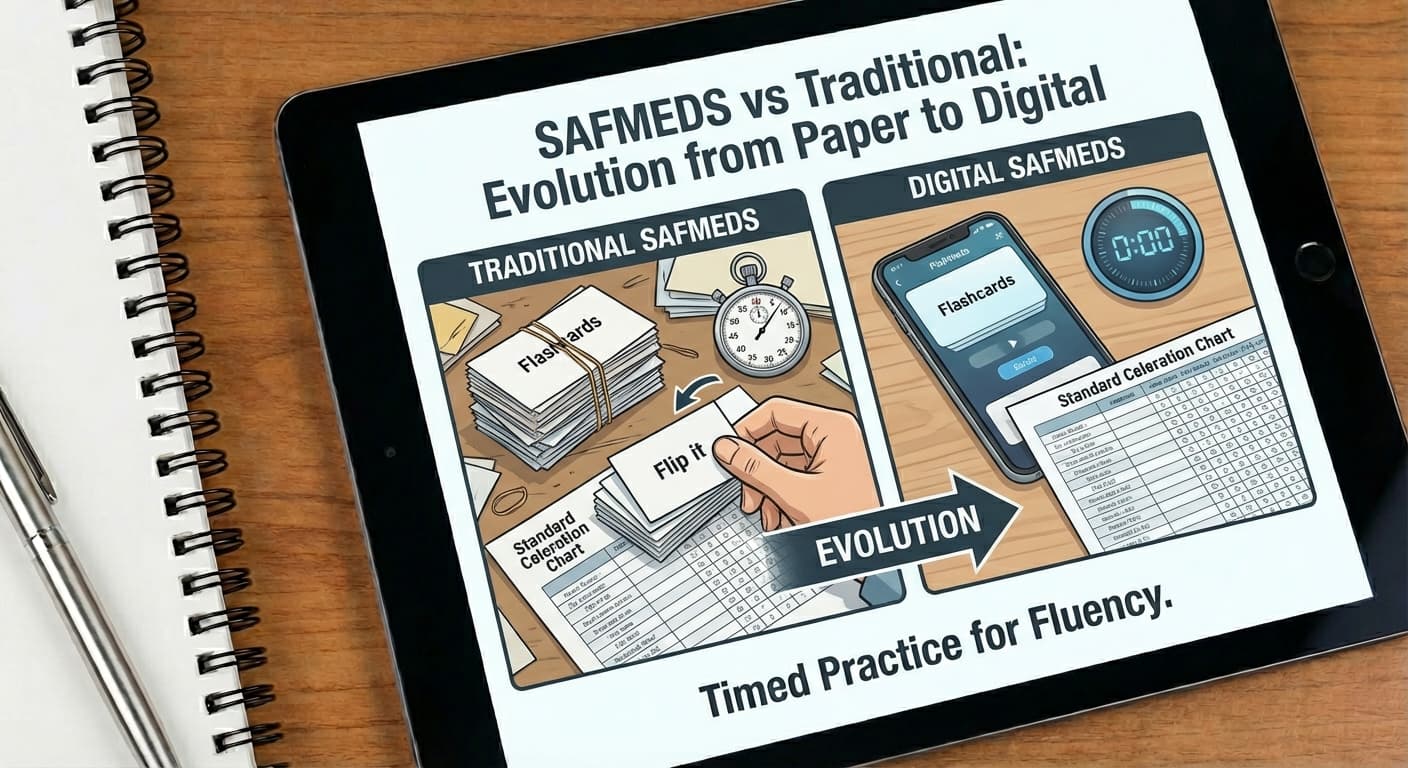
Why can you remember song lyrics from 20 years ago but forget what you studied last week? Why does cramming the night before an exam feel productive but leave you blank during the test?
The answer lies in how memory actually works—and how traditional study habits work against it.
Spaced repetition is one of the most robust findings in learning science. It's not a study trick or productivity hack; it's a fundamental feature of how human memory consolidates information. Understanding this science explains why SAFMEDS works and why "every day" is essential, not optional.
The Spacing Effect: What Research Reveals
The Discovery
In 1885, Hermann Ebbinghaus became the first researcher to systematically study memory. He memorized lists of nonsense syllables and tested himself at various intervals to measure retention. His findings launched a revolution in learning science.
Ebbinghaus discovered that information is forgotten in a predictable pattern—quickly at first, then more slowly over time. More importantly, he found that the same amount of study time produces dramatically different retention depending on how it's distributed.
The fundamental finding: Practice spread over time (spaced) produces far better retention than the same practice compressed into a single session (massed).
The Magnitude of the Effect
How much does spacing help? Studies consistently show:
| Study Pattern | Retention After 1 Week | Retention After 1 Month |
|---|---|---|
| Massed practice (cramming) | 35-45% | 20-30% |
| Spaced practice (distributed) | 60-75% | 50-65% |
| Optimal spacing | 75-85% | 65-80% |
Spaced practice often produces 2x or greater retention compared to cramming—with the same total study time.
How Memory Actually Works
To understand why spacing matters, we need to understand how memories form.
Stage 1: Encoding
When you first encounter information, your brain creates an initial memory trace. This encoding happens in the hippocampus and involves forming new connections between neurons.
Important factors for encoding:
- Attention (focused learning beats distracted learning)
- Meaning (connected information encodes better)
- Effort (harder processing creates stronger traces)
Stage 2: Consolidation
After encoding, memories must be consolidated—strengthened and integrated with existing knowledge. This happens primarily during sleep, as the brain replays and reinforces new connections.
Key insight: Each day's practice requires overnight consolidation before the next practice session can build on it. Cramming prevents this consolidation cycle.
Stage 3: Retrieval
Accessing stored memories isn't like reading a file from a computer. Retrieval is an active process that itself modifies memory. Each successful retrieval strengthens the memory and makes future retrieval easier.
This is critical: The act of remembering something makes it more memorable. Passive review (re-reading) doesn't trigger this strengthening effect.
The Forgetting Curve
What Ebbinghaus Discovered
Ebbinghaus documented that forgetting follows a predictable exponential decay:
| Time After Learning | Retention |
|---|---|
| 20 minutes | ~58% |
| 1 hour | ~44% |
| 1 day | ~34% |
| 1 week | ~25% |
| 1 month | ~21% |
The steepest forgetting happens in the first 24 hours. After that, decay continues but more slowly.
How Retrieval Changes the Curve
Here's where it gets interesting: each successful retrieval not only reinforces the memory but also flattens the forgetting curve. The memory becomes more resistant to decay.
After 1 successful retrieval:
- Forgetting curve becomes less steep
- More information retained at each time point
After 2-3 successful retrievals:
- Forgetting curve flattens significantly
- Information persists for weeks without review
After 4-5+ successful retrievals:
- Forgetting curve approaches horizontal
- Information can persist for months or years
This is why SAFMEDS emphasizes daily practice—each day's retrieval strengthens memory and extends how long it lasts.
Optimal Spacing: When to Review
The Expanding Interval Principle
Research shows that optimal retention comes from expanding intervals—each review should be slightly before you would forget the material.
| Review Number | Optimal Interval |
|---|---|
| 1st review | 1 day after initial learning |
| 2nd review | 3-4 days after 1st review |
| 3rd review | 1 week after 2nd review |
| 4th review | 2-3 weeks after 3rd review |
| 5th review | 1-2 months after 4th review |
As memories strengthen, they can tolerate longer intervals before needing reinforcement.
The Spacing-Retention Tradeoff
There's a nuanced finding: longer intervals produce better long-term retention but feel more difficult in the moment.
| Spacing | Short-Term Performance | Long-Term Retention |
|---|---|---|
| Very short (hours) | Easy, high accuracy | Poor |
| Short (1 day) | Moderate difficulty | Good |
| Medium (3-7 days) | Harder, more errors | Excellent |
| Long (2-4 weeks) | Difficult, many errors | Best (if successful) |
This creates a challenge: optimal spacing feels less productive because errors increase. But those errors—followed by successful retrieval—drive the strongest learning.
Pro Tip
Why Daily Practice Works
The SAFMEDS Approach
SAFMEDS prescribes daily practice for a reason—it threads the needle between several scientific principles:
1. Daily retrieval triggers the testing effect
Each practice session is active retrieval, not passive review. This strengthens memory with every timing.
2. 24-hour spacing allows consolidation
Overnight sleep consolidates each day's learning. Daily practice builds on consolidated foundations.
3. Consistent spacing prevents decay
With daily practice, you never allow significant forgetting to occur. Each session maintains and extends memory.
4. Cumulative retrieval flattens forgetting curves
After weeks of daily practice, information becomes highly resistant to decay.
Why "Most Days" Isn't Enough
The forgetting curve is steepest in the first 24-48 hours. Missing even one day allows significant decay:
| Practice Pattern | Effect |
|---|---|
| Every day | Continuous building; no recovery needed |
| 6 days/week | Minor decay on day off; quick recovery |
| 4-5 days/week | Noticeable decay; some review spent on recovery |
| 2-3 days/week | Significant decay; most review is recovery, not progress |
The Neuroscience of Spacing
What Happens in the Brain
Modern neuroimaging research has revealed what happens during spaced vs. massed learning:
During spaced learning:
- Hippocampal activity increases with each spaced retrieval
- Connections between neurons strengthen through long-term potentiation (LTP)
- Memory traces gradually transfer from hippocampus to cortex (systems consolidation)
- Neural networks become more efficient at accessing information
During massed learning:
- Initial hippocampal activity is high but doesn't strengthen as much
- LTP occurs but is less stable
- Limited systems consolidation due to lack of sleep between sessions
- Memory remains dependent on hippocampus (more vulnerable to disruption)
The Role of Sleep
Sleep isn't just rest—it's active memory processing. During sleep:
- Memory replay: The hippocampus "replays" recent learning
- Synaptic consolidation: Connections are strengthened or pruned
- Systems consolidation: Memories integrate with existing knowledge
- Emotional processing: Memory importance is evaluated
Cramming eliminates these overnight consolidation benefits. Spaced practice maximizes them.
Spaced Repetition vs. Massed Practice
Head-to-Head Comparison
| Factor | Massed Practice (Cramming) | Spaced Repetition |
|---|---|---|
| Immediate performance | High | Moderate |
| 1-week retention | Low (35-45%) | High (60-75%) |
| 1-month retention | Very low (20-30%) | Good (50-65%) |
| Transfer to new contexts | Poor | Good |
| Resistance to stress | Low | High |
| Efficiency (learning per minute) | Low | High |
Why Cramming Feels Effective
Students continue cramming despite evidence against it because:
- Fluency illusion: Information feels known immediately after study
- Familiarity ≠ recall: Recognizing material differs from retrieving it
- Short-term success: Cramming can work for immediate tests
- Effort misattribution: Harder practice feels less productive
The spacing effect fights against our intuitions about what works.
Research Evidence: Meta-Analyses
Cepeda et al. (2006)
This landmark meta-analysis reviewed 254 studies involving over 14,000 participants:
Key findings:
- Spacing consistently outperforms massing across all conditions
- Optimal spacing depends on retention interval (longer retention → longer optimal spacing)
- Effect sizes are large (d = 0.4-0.9)
- Benefits appear across all ages, materials, and testing conditions
Dunlosky et al. (2013)
This comprehensive review rated learning strategies by effectiveness:
| Strategy | Effectiveness Rating |
|---|---|
| Distributed practice (spacing) | High |
| Practice testing | High |
| Interleaved practice | Moderate |
| Elaborative interrogation | Moderate |
| Self-explanation | Moderate |
| Highlighting | Low |
| Rereading | Low |
| Summarization | Low |
Spacing and testing—the core elements of SAFMEDS—received the highest effectiveness ratings.
Kang (2016)
This review focused specifically on educational applications:
Conclusions:
- Spacing benefits transfer to classroom learning
- Effects are robust across subject matters
- Implementation challenges exist but are surmountable
- Technology can facilitate optimal spacing
Practical Applications for SAFMEDS
How SAFMEDS Implements Spacing Science
SAFMEDS incorporates spacing principles through:
Daily practice requirement:
- Ensures minimum 24-hour spacing between sessions
- Aligns with consolidation research
- Prevents decay below recovery threshold
Multiple timings per session:
- Each timing is spaced by minutes within a session
- Provides immediate retrieval practice
- Builds on same-session consolidation
Long-term practice schedules:
- Weeks of daily practice before moving on
- Multiple retrievals flatten forgetting curve
- Creates highly durable memory
Optimizing Your Practice Schedule
| Goal | Recommended Pattern |
|---|---|
| Maximum long-term retention | Daily practice, 3-5 timings, for 2-4 weeks |
| Exam preparation | Daily practice starting 6-8 weeks before exam |
| Maintenance of learned material | Spacing out to every 2-3 days after fluency achieved |
| Learning new content | Daily practice until fluency aims met |
Using TAFMEDS for Optimal Spacing
TAFMEDS helps implement spacing by:
- Tracking practice dates: Ensures you don't miss days
- Scheduling reminders: Prompts practice at optimal intervals
- Visualizing consistency: Shows practice streaks and gaps
- Adapting to performance: Can adjust card presentation based on mastery
Common Misconceptions
Misconception 1: "More practice in one session is better"
Reality: Diminishing returns set in quickly. After 15-20 minutes on one deck, additional practice adds little. That time is better spent resting and practicing tomorrow.
Misconception 2: "Spacing only matters for memorization"
Reality: Spacing benefits extend to:
- Conceptual understanding
- Skill acquisition
- Problem-solving ability
- Transfer to new situations
Misconception 3: "Technology can replace spacing"
Reality: While spaced repetition software optimizes intervals, nothing replaces actual elapsed time. You can't "speed up" consolidation.
Misconception 4: "Some people don't need spacing"
Reality: The spacing effect is universal. No population or individual has been found to not benefit from distributed practice. The magnitude varies, but the direction is constant.
The Desirable Difficulties Framework
What Are Desirable Difficulties?
Psychologist Robert Bjork coined "desirable difficulties" to describe conditions that make learning harder moment-to-moment but better long-term.
Desirable difficulties include:
- Spacing practice sessions (vs. massing)
- Varying practice conditions (vs. constant conditions)
- Interleaving different skills (vs. blocking)
- Testing/retrieval (vs. restudying)
- Generating answers (vs. reading answers)
SAFMEDS incorporates multiple desirable difficulties:
- Spacing: Daily practice, not cramming
- Testing: Active retrieval, not passive review
- Generation: Producing answers, not recognizing them
- Variation: Shuffled cards vary context
Why Difficulty Helps
Effortful processing creates stronger encoding and retrieval pathways. When retrieval is easy, the brain invests minimal resources. When retrieval requires effort, the brain strengthens pathways to make future retrieval easier.
Building Spaced Practice Habits
Making Daily Practice Sustainable
Spacing works best when it's consistent over time. Strategies for maintaining daily practice:
1. Habit stacking
Link SAFMEDS to an existing daily habit:
- After morning coffee → SAFMEDS practice
- Before bed → SAFMEDS practice
- During lunch break → SAFMEDS practice
2. Environmental design
Make practice easy to start:
- Keep cards/app visible and accessible
- Remove barriers to beginning
- Create a dedicated practice space
3. Identity-based commitment
Shift from "I do SAFMEDS" to "I'm someone who practices daily":
- Track your practice streak
- Celebrate consistency
- See missed days as exceptions, not patterns
The Minimum Effective Dose
If pressed for time, the minimum effective dose is:
- 3 one-minute timings (3 minutes active practice)
- Once per day, every day
- At the same time when possible
This maintains the spacing effect even when full practice isn't possible.
Conclusion
Spaced repetition isn't a study technique—it's how memory works. The science is clear:
- Forgetting follows a predictable curve that steepens without review
- Retrieval strengthens memory more than re-exposure
- Spacing allows consolidation that cramming prevents
- Daily practice compounds into durable long-term retention
- The testing effect and spacing effect combine for optimal learning
SAFMEDS leverages these principles systematically. The "Every Day" isn't arbitrary—it's the practical application of decades of memory research. The timed element isn't just for measurement—it ensures active retrieval rather than passive recognition.
When you practice SAFMEDS daily, you're not just learning content. You're working with your brain's architecture instead of against it. You're building memory that lasts, performs under pressure, and transfers to real-world application.
The science is on your side. Your only job is to show up every day.
Experience optimized spaced repetition with TAFMEDS—the app that ensures your practice follows the science.
Related Articles
- What is SAFMEDS? The Complete Guide - Understand the methodology
- Why 60 Seconds Changes Everything - The science of timed practice
- 5 Common SAFMEDS Mistakes - Including skipping days
References
- Bjork, R. A., & Bjork, E. L. (2011). Making things hard on yourself, but in a good way: Creating desirable difficulties to enhance learning. In M. A. Gernsbacher, R. W. Pew, L. M. Hough, & J. R. Pomerantz (Eds.), *Psychology and the real world: Essays illustrating fundamental contributions to society* (pp. 56-64). Worth Publishers.
- Cepeda, N. J., Pashler, H., Vul, E., Wixted, J. T., & Rohrer, D. (2006). Distributed practice in verbal recall tasks: A review and quantitative synthesis. *Psychological Bulletin, 132*(3), 354-380.
- Dunlosky, J., Rawson, K. A., Marsh, E. J., Nathan, M. J., & Willingham, D. T. (2013). Improving students' learning with effective learning techniques: Promising directions from cognitive and educational psychology. *Psychological Science in the Public Interest, 14*(1), 4-58.
- Ebbinghaus, H. (1885/1964). *Memory: A contribution to experimental psychology*. New York: Dover.
- Kang, S. H. K. (2016). Spaced repetition promotes efficient and effective learning: Policy implications for instruction. *Policy Insights from the Behavioral and Brain Sciences, 3*(1), 12-19.
- Karpicke, J. D., & Roediger, H. L. (2008). The critical importance of retrieval for learning. *Science, 319*(5865), 966-968.
- Roediger, H. L., & Butler, A. C. (2011). The critical role of retrieval practice in long-term retention. *Trends in Cognitive Sciences, 15*(1), 20-27.
- Soderstrom, N. C., & Bjork, R. A. (2015). Learning versus performance: An integrative review. *Perspectives on Psychological Science, 10*(2), 176-199.