You studied hard. You knew the material. You could answer every question correctly during practice. Then the exam came—and your mind went blank.
What happened? You had accuracy but not fluency. And without fluency, knowledge is fragile.
The difference between fragile knowledge and robust, usable learning can be captured in four outcomes: Retention, Endurance, Stability, and Application—collectively known as RESA. These outcomes don't just describe what fluency produces; they define what fluency *is*.
What Are the RESA Outcomes?
The Fluency Framework
RESA represents the four behavioral outcomes that emerge when learning reaches true fluency. Carl Binder, building on decades of Precision Teaching research, identified these as the distinguishing features of fluent performance.
| Outcome | Definition | Question It Answers |
|---|---|---|
| Retention | Maintaining performance over time without practice | "Will I remember this later?" |
| Endurance | Sustaining performance over extended periods | "Can I keep going without fatigue?" |
| Stability | Maintaining performance despite distractions | "Will I perform under pressure?" |
| Application | Using knowledge in new contexts | "Can I apply this to real situations?" |
When all four RESA outcomes are present, you have genuine fluency. When any are missing, you have something less—accurate but fragile performance that fails when conditions change.
Why Accuracy Isn't Enough
Consider two students who both score 100% on a practice quiz:
Student A (Accurate but not fluent):
- Takes 45 seconds per question
- Needs quiet, focused conditions
- Forgets 40% within two weeks
- Can't apply knowledge to novel scenarios
Student B (Fluent):
- Answers in 3-5 seconds per question
- Performs consistently despite noise
- Retains 85%+ after two weeks
- Transfers knowledge to new situations
Same accuracy. Completely different learning outcomes. The difference is fluency—and the RESA outcomes reveal it.
Retention: Learning That Lasts
What Is Retention?
Retention is the ability to maintain performance over time without continued practice. It's what remains after you stop studying and time passes.
High retention:
- Information accessible weeks or months later
- Minimal review needed to restore performance
- Learning survives the forgetting curve
Low retention:
- Rapid decay after practice stops
- Extensive re-learning required
- "Use it or lose it" applies strongly
Why Fluency Produces Better Retention
The relationship between fluency and retention is well-documented (rates below are from spoken-channel research; typed-channel rates run 2-3x lower at the same fluency level):
| Performance Level (spoken) | Typical Retention (2 weeks) |
|---|---|
| Accurate but slow (15/min) | 40-55% |
| Moderate fluency (30/min) | 60-75% |
| High fluency (50+/min) | 80-95% |
This isn't coincidental. Fluent performance creates:
- Stronger memory traces: More retrievals = stronger encoding
- Automaticity: Automatic responses resist decay better than deliberate ones
- Deeper processing: Speed requires understanding, not just recognition
Testing Your Retention
To verify retention, practice a deck you haven't touched in 2+ weeks:
| Post-Break Performance | Retention Level | Implication |
|---|---|---|
| 90%+ of original | Excellent | True fluency achieved |
| 70-89% of original | Good | Fluent, needs periodic review |
| 50-69% of original | Fair | Approaching fluency, not quite there |
| Below 50% of original | Poor | More practice needed before break |
Endurance: Sustained Performance
What Is Endurance?
Endurance is the ability to maintain performance quality over extended periods of responding. It answers: "Can you keep going?"
High endurance:
- Consistent performance across a 4-hour exam
- No significant decline in accuracy or speed with time
- Sustained focus without cognitive fatigue
Low endurance:
- Strong start, declining performance
- Accuracy drops as time passes
- Mental exhaustion affects later responses
Why Fluency Builds Endurance
Fluent performance is automatic—it requires less cognitive effort per response. This conservation of mental resources enables sustained performance.
Think of it like the difference between:
- Deliberate recall: Like walking through mud—exhausting
- Automatic recall: Like walking on pavement—sustainable
When retrieval is effortful, each response depletes your cognitive resources. When retrieval is automatic, you can maintain performance indefinitely.
Endurance in Exam Contexts
Exam endurance matters tremendously:
| Exam | Duration | Questions | Why Endurance Matters |
|---|---|---|---|
| BCBA | 4 hours | 185 | Must maintain focus throughout |
| BCaBA | 4 hours | 160 | Later questions matter as much as earlier |
| RBT | 90 min | 85 | Concentrated effort required |
Students with low endurance show predictable patterns:
- Strong performance on questions 1-50
- Declining accuracy on questions 51-100
- Errors from fatigue, not knowledge gaps
Building Endurance Through SAFMEDS
SAFMEDS naturally builds endurance:
- Timed practice requires sustained effort
- Multiple timings train extended performance
- Speed building develops automaticity
- Daily practice conditions cognitive stamina
Stability: Performance Under Pressure
What Is Stability?
Stability is maintaining performance despite distractions, stress, or challenging conditions. It's the resilience of your learning.
High stability:
- Same performance in quiet room or noisy café
- Consistent accuracy despite test anxiety
- Reliable recall even when tired or stressed
Low stability:
- Performance heavily dependent on conditions
- Anxiety dramatically reduces accuracy
- Environmental factors disrupt recall
The Stability-Fluency Connection
Why does fluency produce stability? Because automatic processes are harder to disrupt than controlled processes.
| Process Type | Cognitive Load | Vulnerability to Disruption |
|---|---|---|
| Controlled (slow, deliberate) | High | Very vulnerable |
| Automatic (fast, effortless) | Low | Resistant |
When you have to *think* to recall, anything that interferes with thinking disrupts recall. When recall is automatic, your conscious mind can handle distractions while retrieval proceeds unimpeded.
Exam Stability
Consider what happens during a high-stakes exam:
Without stability:
- Test anxiety consumes cognitive resources
- Deliberate retrieval competes with worry
- Performance drops significantly from practice levels
With stability (fluency):
- Automatic retrieval proceeds despite anxiety
- Cognitive resources handle anxiety without affecting recall
- Performance matches or approaches practice levels
Application: Transfer to New Contexts
What Is Application?
Application is using learned knowledge in new situations—applying concepts to novel scenarios, solving unfamiliar problems, and transferring skills to real-world contexts.
High application:
- Can identify reinforcement in novel scenarios
- Applies principles to situations not explicitly studied
- Generalizes from examples to underlying concepts
Low application:
- Only recognizes studied examples
- Can't transfer to slightly different situations
- Knowledge is bound to original learning context
Why Fluency Enables Application
Application requires cognitive resources. When basic knowledge retrieval is effortful, there's nothing left for higher-order thinking.
| Without Fluency | With Fluency |
|---|---|
| "What is reinforcement again... let me think..." | Automatic: "reinforcement = increases behavior" |
| Cognitive load: Retrieval + Application | Cognitive load: Application only |
| Often fails—overloaded | Often succeeds—resources available |
Fluent foundational knowledge frees working memory for application, analysis, and synthesis.
Application in Professional Practice
For behavior analysts, application is the point:
- Knowing the definition of extinction isn't enough
- Applying extinction appropriately to client scenarios is the goal
- Fluent terminology enables focus on application decisions
Certification exams test application specifically because that's what matters in practice.
How SAFMEDS Builds All Four RESA Outcomes
The SAFMEDS-RESA Connection
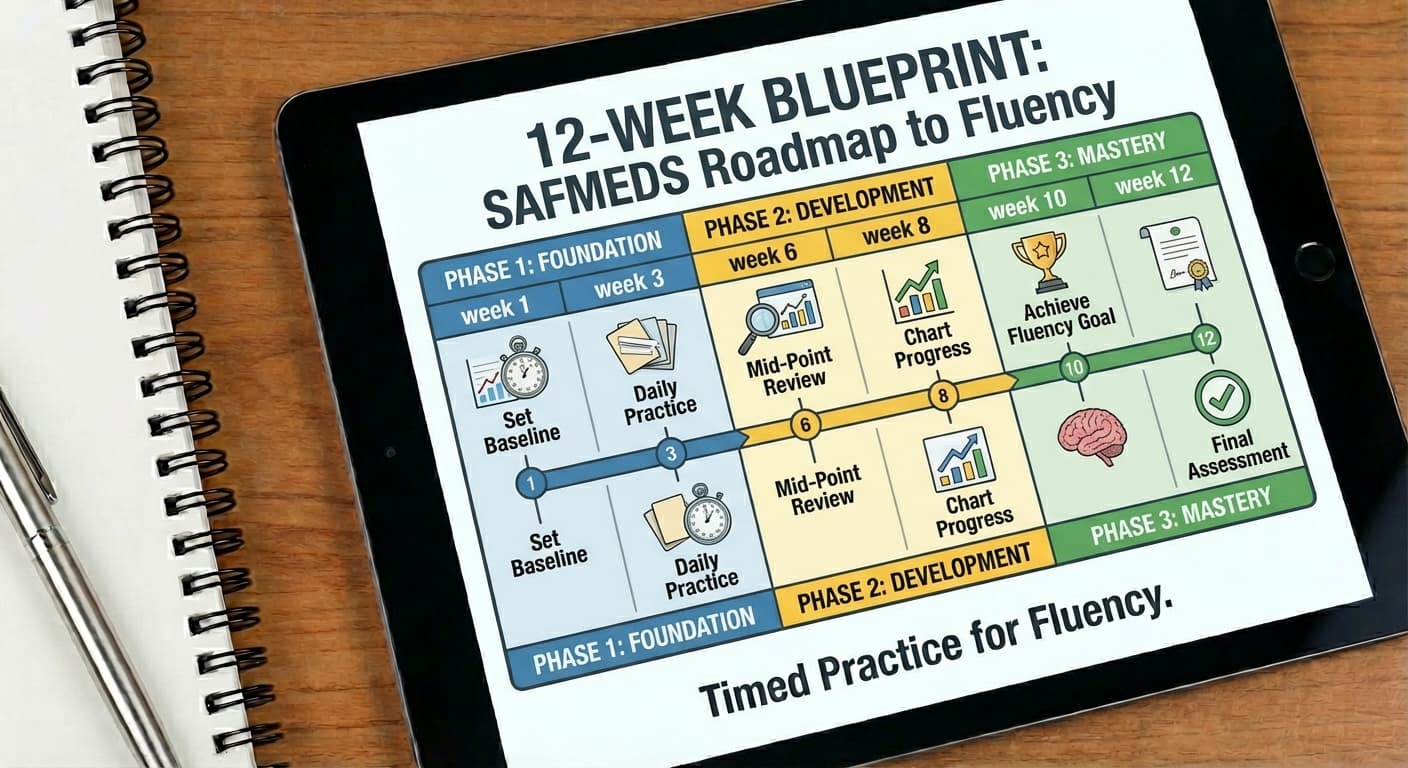
SAFMEDS isn't designed to produce accuracy—it's designed to produce RESA:
| SAFMEDS Element | RESA Outcome Targeted |
|---|---|
| Timed practice | Builds speed → Retention, Endurance, Stability |
| Daily practice | Spaced repetition → Retention |
| Multiple timings | Extended practice → Endurance |
| Speed pressure | Automaticity → Stability, Application |
| Shuffled cards | Varied context → Stability, Application |
The Fluency Threshold
Research suggests specific performance levels predict RESA outcomes. The published thresholds come from spoken-channel studies; the typed-channel equivalents scale down with the channel's ceiling:
| Fluency Level (spoken) | Typed Equivalent | RESA Outcomes Expected |
|---|---|---|
| Below 20/min | Below 6/min | Minimal—fragile knowledge |
| 20-35/min | 6-10/min | Partial—some retention and endurance |
| 35-50/min | 10-15/min | Good—most RESA outcomes present |
| 50+/min | 15+/min | Excellent—full RESA achieved |
These aren't arbitrary numbers—the spoken thresholds are derived from studies correlating speed with later retention and transfer; typed equivalents follow from the channel's typing-bounded ceiling.
Verifying Your RESA Outcomes
Test whether your practice is producing RESA:
Retention Test:
- Stop practicing a fluent deck for 2 weeks
- Test without warm-up
- Compare to previous performance
Endurance Test:
- Do 10 consecutive timings
- Compare timing 1 to timing 10
- Stable performance = endurance achieved
Stability Test:
- Practice in a distracting environment
- Practice when tired or stressed
- Consistent performance = stability achieved
Application Test:
- Review scenarios that use the concepts
- Can you identify concepts in novel examples?
- Successful transfer = application achieved
RESA Failures: When Accuracy Deceives
Case Study: The Perfect Practice Score
Scenario: A student practices BCBA terminology daily. They achieve 100% accuracy every session. They feel confident.
Exam day: They score 68%—a failing grade.
What happened: They had accuracy without fluency. Their performance lacked:
- Retention: They studied right before the exam
- Endurance: Performance dropped after 2 hours
- Stability: Test anxiety disrupted deliberate recall
- Application: They couldn't apply definitions to scenarios
Case Study: The Speed Builder
Scenario: A student builds speed using SAFMEDS. They achieve 55 correct/minute with 88% accuracy. Some errors concern them.
Exam day: They score 84%—a comfortable pass.
What happened: Fluency produced RESA despite imperfect practice accuracy:
- Retention: High-speed practice created durable memory
- Endurance: Automatic retrieval sustained through 4 hours
- Stability: Fluent recall functioned despite anxiety
- Application: Freed cognitive resources for scenario analysis
Building RESA Into Your Practice
Daily Habits for RESA
| Habit | RESA Outcome |
|---|---|
| Timed practice (always) | All four |
| Multiple timings (3-5 per session) | Endurance |
| Varied conditions (sometimes) | Stability |
| Spaced practice (daily) | Retention |
| Application exercises (regularly) | Application |
Weekly Verification
Check one RESA outcome each week:
- Week 1: Test retention on an older deck
- Week 2: Do extended timing sessions (endurance)
- Week 3: Practice in challenging conditions (stability)
- Week 4: Work application-focused practice questions
Pre-Exam RESA Check
Before any high-stakes exam:
- Retention: Can you perform on decks you haven't practiced in a week?
- Endurance: Can you maintain performance across a mock exam length?
- Stability: Can you perform under simulated exam stress?
- Application: Can you apply concepts to novel scenarios?
If any RESA outcome is weak, address it before the exam.
Conclusion
Accuracy is necessary but not sufficient. True learning—the kind that performs when it matters—requires fluency that produces all four RESA outcomes:
- Retention: Learning that survives time
- Endurance: Performance that sustains effort
- Stability: Recall that resists disruption
- Application: Knowledge that transfers
SAFMEDS isn't just a method for memorizing definitions. It's a system for building robust, durable, applicable knowledge—the kind that passes exams and serves professional practice.
When you evaluate your learning, don't ask "Do I know this?" Ask:
- "Will I remember this next month?" (Retention)
- "Can I perform for four hours?" (Endurance)
- "Will I recall this under stress?" (Stability)
- "Can I use this in new situations?" (Application)
If the answer to all four is yes, you have fluency. If not, keep building.
Build RESA outcomes with TAFMEDS—practice that produces learning that lasts.
Related Articles
- What is SAFMEDS? The Complete Guide - The methodology that builds RESA
- The Science of Spaced Repetition - How spacing produces retention
- Setting Fluency Aims - Targets that predict RESA achievement
References
- Binder, C. (1996). Behavioral fluency: Evolution of a new paradigm. *The Behavior Analyst, 19*(2), 163-197.
- Binder, C., & Watkins, C. L. (1990). Precision teaching and direct instruction: Measurably superior instructional technology in schools. *Performance Improvement Quarterly, 3*(4), 74-96.
- Johnson, K. R., & Layng, T. V. J. (1996). On terms and procedures: Fluency. *The Behavior Analyst, 19*(2), 281-288.
- Kubina, R. M., & Morrison, R. S. (2000). Fluency in education. *Behavior and Social Issues, 10*, 83-99.
- Lindsley, O. R. (1996). The four free-operant freedoms. *The Behavior Analyst, 19*(2), 199-210.
- Doughty, S. S., Chase, P. N., & O'Shields, E. M. (2004). Effects of rate building on fluent performance: A review and meta-analysis. *The Behavior Analyst, 27*(1), 7-26.