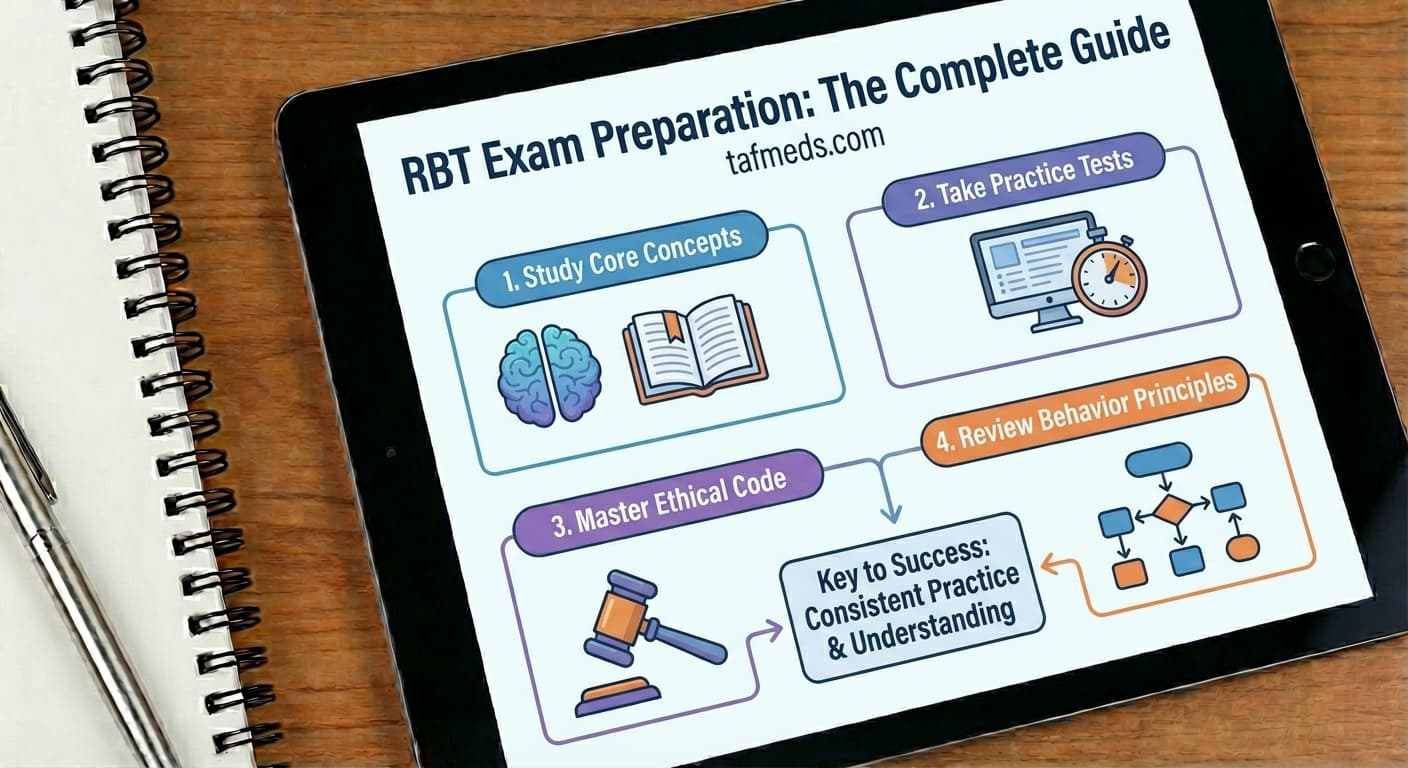
Preparing for the Board Certified Behavior Analyst (BCBA) certification exam requires more than just reading textbooks and reviewing flashcards. Mock exams are one of the most powerful tools in your exam preparation arsenal—but only if you use them strategically.
In this guide, we'll explore evidence-based approaches to maximize the value of your BCBA mock exam practice, helping you build both competence and confidence before test day.
Why Mock Exams Matter
Mock exams serve multiple critical functions in your preparation:
- Identify Knowledge Gaps - Pinpoint specific TCO domains where you need more study
- Build Test-Taking Stamina - Develop the endurance for a 4-hour exam
- Reduce Test Anxiety - Familiarity with the format reduces stress
- Practice Time Management - Learn to pace yourself across 175 questions
- Apply Concepts - Move from passive knowledge to active application
The BCBA Exam Structure
Before diving into strategies, let's review what you're preparing for:
| Component | Details |
|---|---|
| Total Questions | 185 (175 scored, 10 pilot) |
| Time Limit | 4 hours |
| Format | Multiple choice, scenario-based |
| Passing Score | Criterion-referenced (varies) |
| Domains | 9 content domains (A–I) |
TCO Domain Weights
The BACB 6th Edition Test Content Outline splits the 175 scored questions across nine content domains (A–I). Understanding the distribution helps you allocate study time:
- Domain A (Behaviorism and Philosophical Foundations): 8 questions (~5%)
- Domain B (Concepts and Principles): 24 questions (~14%)
- Domain C (Measurement, Data Display, and Interpretation): 21 questions (~12%)
- Domain D (Experimental Design): 13 questions (~7%)
- Domain E (Ethical and Professional Issues): 22 questions (~13%)
- Domain F (Behavior Assessment): 23 questions (~13%)
- Domain G (Behavior-Change Procedures): 25 questions (~14%)
- Domain H (Selecting and Implementing Interventions): 20 questions (~11%)
- Domain I (Personnel Supervision and Management): 19 questions (~11%)
Strategic Mock Exam Schedule
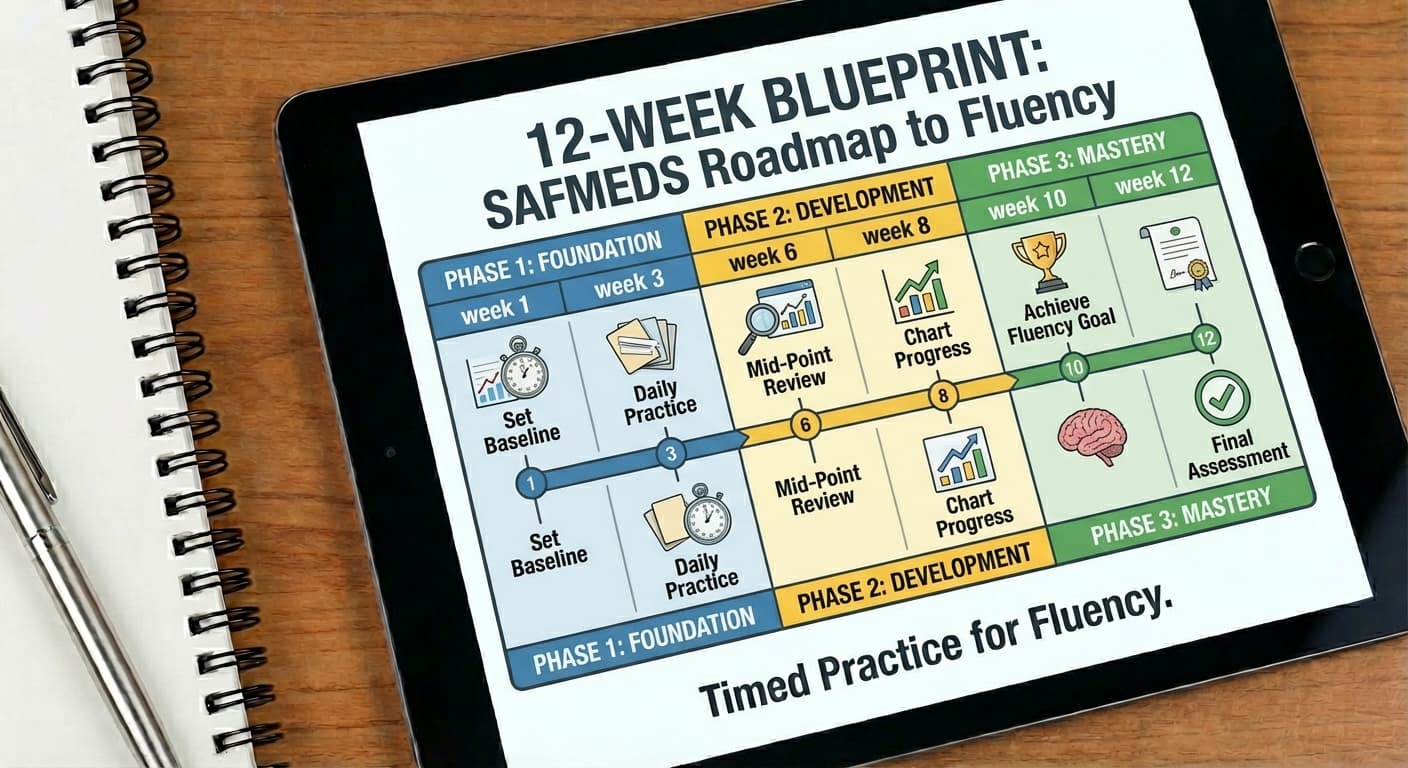
Phase 1: Diagnostic Assessment (8-12 Weeks Before Exam)
Take your first full-length mock exam before intensive studying begins. This establishes your baseline and identifies priority areas.
What to do:
- Complete a full 175-question exam under timed conditions
- Don't review answers during the exam
- Score yourself and analyze results by domain
- Create a study plan based on your weakest areas
Phase 2: Domain-Focused Practice (6-8 Weeks Before)
After identifying weak areas, use domain-specific practice:
- Take 20-30 question mini-exams focusing on specific TCO domains
- Review rationales for every question (correct and incorrect)
- Track your improvement over time
- Spend extra time on the domains your diagnostic exam flagged
Phase 3: Integration Practice (3-5 Weeks Before)
Return to full-length mock exams to practice integration:
- Take one full mock exam per week
- Simulate real exam conditions (quiet space, timed, no breaks)
- After each exam, create a "missed concepts" study list
- Focus on questions you got wrong or guessed on
Phase 4: Final Preparation (1-2 Weeks Before)
Reduce intensity but maintain sharpness:
- Take one final mock exam 5-7 days before the real exam
- Focus on review, not learning new material
- Practice relaxation techniques
- Get adequate sleep
How to Analyze Your Mock Exam Results
Simply taking mock exams isn't enough—analysis is where the learning happens.
Step 1: Categorize Your Errors
After each mock exam, classify every missed question:
| Error Type | Description | Action |
|---|---|---|
| Content Gap | Didn't know the concept | Review relevant material |
| Misreading | Misunderstood the question | Practice careful reading |
| Application Error | Knew concept, applied incorrectly | Work through more scenarios |
| Careless Mistake | Knew answer, selected wrong option | Develop checking routine |
Step 2: Track Domain Performance
Create a simple spreadsheet tracking your scores by domain across multiple mock exams:
```
Mock Exam 1: Domain A: 75%, Domain B: 80%, Domain C: 65%...
Mock Exam 2: Domain A: 80%, Domain B: 82%, Domain C: 72%...
```
This reveals whether your focused study is working.
Step 3: Review Rationales Deeply
For every question—even ones you got right—read the rationale:
- Correct answers: Confirm your reasoning was correct
- Incorrect answers: Understand why each distractor is wrong
- Flagged questions: Return to ones where you were unsure
Scenario-Based Question Strategies
The BCBA exam features scenario-based questions that require applying concepts to real-world situations.
Reading the Scenario
- Identify the client - Who is receiving services?
- Note the behavior - What behavior is being addressed?
- Find the data - What measurement information is provided?
- Understand the context - What setting and circumstances?
Common Scenario Traps
- Avoid absolute language - Answers with "always" or "never" are often incorrect
- Consider ethics first - When in doubt, the most ethical option is usually correct
- Match the cognitive level - Higher-level questions require analysis, not just recall
Time Management During Mock Exams
With 4 hours for 185 questions, you have approximately 1.3 minutes per question.
Recommended Approach
- First Pass (2.5 hours)
- Answer questions you know immediately
- Flag uncertain questions and move on
- Don't spend more than 90 seconds on any question
- Second Pass (1 hour)
- Return to flagged questions
- Use process of elimination
- Make educated guesses if needed
- Final Review (30 minutes)
- Check for unanswered questions
- Review flagged items one more time
- Don't change answers unless you have a clear reason
Common Mistakes to Avoid
Mistake 1: Taking Too Many Mock Exams
Mistake 2: Not Simulating Real Conditions
Practice like you'll perform:
- Use a timer
- Take the exam in one sitting
- Avoid distractions
- Don't look up answers during the exam
Mistake 3: Ignoring Emotional Preparation
Test anxiety is real. Mock exams help by:
- Building familiarity with the format
- Developing confidence through improvement
- Creating positive testing experiences
Mistake 4: Focusing Only on Weak Areas
While prioritizing weak areas is important, don't neglect strong areas:
- Maintain competence in all domains
- Strong areas can compensate for weaker ones
- Confidence in strong areas reduces overall anxiety
Using TAFMEDS Mock Exams
Our mock exam system is designed to align with the BACB Item Development Guidelines:
Features That Support Effective Practice
- Realistic Scenarios - 2-4 sentence scenarios mirroring the actual exam
- Domain Analytics - Track performance across all 9 content domains (A–I)
- Cognitive Level Distribution - Questions at all Bloom's taxonomy levels
- Detailed Rationales - Learn why each answer is correct or incorrect
- Timed Practice - 4-hour timer with pause functionality
Recommended Practice Modes
- Full Exam Mode - Complete 175-question exam for stamina building
- Domain Practice - Focus on specific TCO domains
- Review Mode - Revisit completed exams and analyze errors
Your Action Plan
Ready to implement these strategies? Here's your week-by-week guide:
This Week
- [ ] Take a diagnostic mock exam to establish baseline
- [ ] Analyze results and identify your 3 weakest domains
- [ ] Create a study schedule prioritizing these areas
Next 4 Weeks
- [ ] Take domain-focused practice exams weekly
- [ ] Review all rationales thoroughly
- [ ] Track improvement by domain
Final 2 Weeks
- [ ] Complete 2 full-length mock exams
- [ ] Focus on review, not new learning
- [ ] Practice relaxation and confidence-building
Conclusion
Mock exams are not just practice—they're a strategic tool for learning. By following the approaches outlined in this guide, you'll maximize the value of every practice exam you take.
Remember: The goal isn't to memorize mock exam questions. It's to develop the analytical skills and content knowledge that will serve you on any question the real exam presents.
Ready to start practicing? Try our BCBA Mock Exam with scenario-based questions aligned to the BACB 6th Edition TCO.
Want more exam prep strategies? Check out our BCBA Exam Study Blueprint: 12-Week Guide for a comprehensive study plan.