Midsemester can make every unfinished reading and missed quiz question feel equally urgent. If your ABA study plan has become “catch up on everything,” give this week a smaller job: work on one concept you can name.
Start with evidence from your coursework, choose a focused practice set, and check both recall and understanding. The seven-day plan below gives that work a place in your week. Seven days is a planning interval, not a promise that a difficult topic will be resolved by Sunday.
Name the difficulty before choosing the deck
Look at a recent quiz, assignment comment, or practice result. Find one recurring problem you can describe without using “everything,” “always,” or “bad at.”
“I struggle with reinforcement” is a broad starting point. “I call a consequence negative reinforcement whenever something is removed, without checking what happens to future behavior” gives you something specific to study.
Write down three things:
- The distinction: What am I confusing?
- The evidence: Which answer or instructor comment showed the problem?
- The task: What should I be able to explain or do differently?
For this example, the task is to distinguish positive and negative reinforcement in a short scenario and explain the evidence for your answer. Your own topic might be a measurement definition or the difference between two schedules.
Choose material that answers that question
Open the TAFMEDS deck library and look for a deck whose description matches your topic. For the reinforcement example, the catalog includes AB540 Unit 3: Positive Reinforcement and AB540 Unit 3: Negative Reinforcement. Check the terms against your assigned reading; a course label does not establish that the material matches your syllabus.
The Free plan includes designated free decks, including complete course decks. BCBA Foundations Sampler is another free starting option when its coverage fits your goal. Other catalog decks require paid access, so check the access information in your account before choosing one. You do not need to upgrade to follow this worksheet with a suitable free deck.
If a ready-made deck is too broad, make a small personal set from your own notes. Give each prompt one clear task and check the expected answer against your course source. Free accounts can create up to three personal decks. Keep longer explanations and scenarios in a separate notebook exercise.
Find a deck for your weak topic: Browse the library, note the deck name, and reserve your first practice visit.
Check the concept before practicing its label
For reinforcement, “positive” and “negative” describe whether a stimulus is added or removed. Both involve an increase in the future likelihood of the behavior. They do not mean good and bad, and negative reinforcement is not punishment. OpenStax's operant conditioning chapter explains these distinctions.
Consider two simplified examples:
- A volunteer receives appreciative feedback after returning shared equipment on time. On-time returns subsequently become more frequent. Feedback was added, and the behavior increased: positive reinforcement.
- A driver fastens a seat belt, stopping an audible reminder. Fastening the belt when the reminder sounds subsequently becomes more likely. The sound was removed, and the behavior increased: negative reinforcement.
Now remove the sentence about subsequent behavior. What information is missing? The effect on future behavior. A consequence's appearance or intention alone does not establish reinforcement, as the IRIS Center's explanation of consequences emphasizes.
Use this kind of explanation check alongside your terminology practice. Ask your instructor about examples you cannot confidently classify.
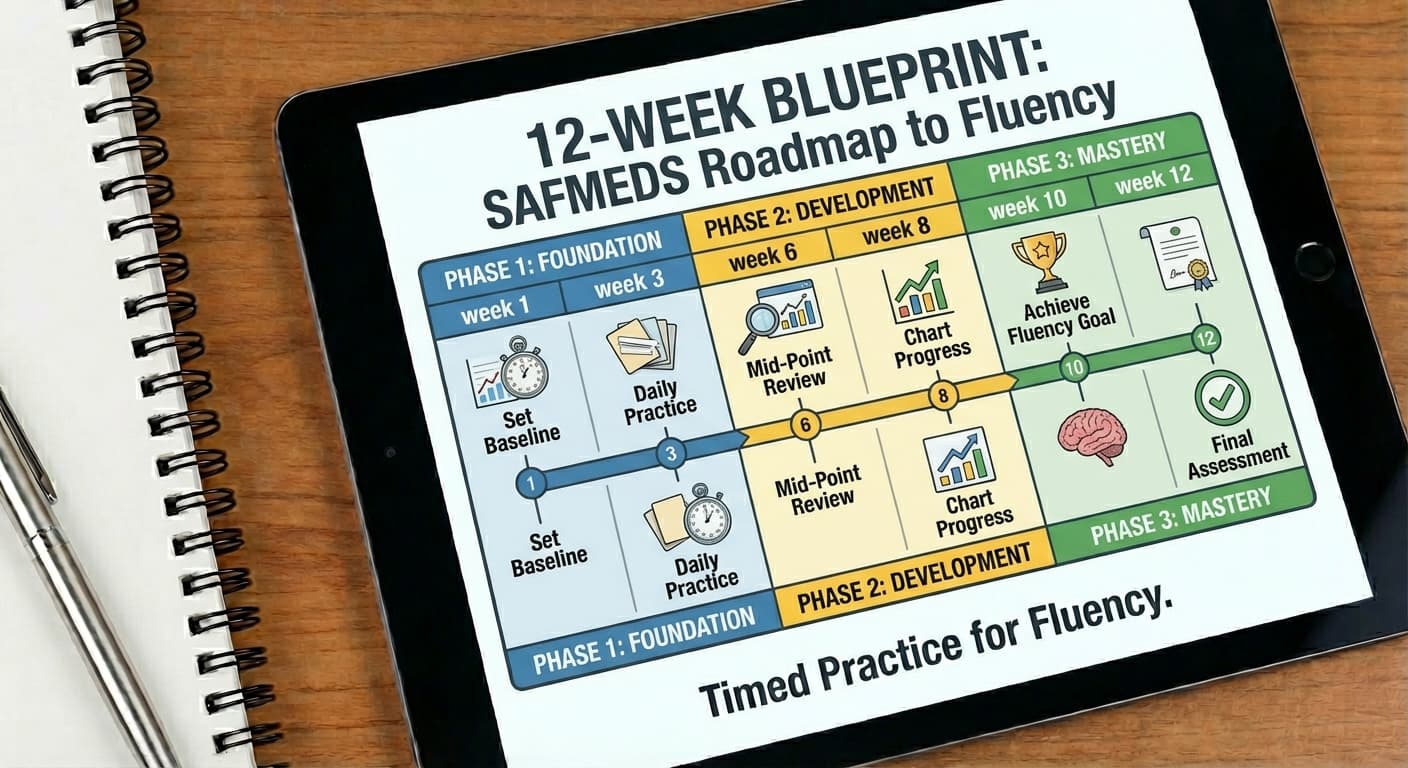
Use the seven-day worksheet
Copy this table into your notes and add dates that fit your schedule. Allow time to review answers after practice. These are suggested activities, not a prescribed treatment or a tested dose of study.
| Day | Focus | Record before you finish |
|---|---|---|
| 1 | Review one quiz or assignment; choose the distinction and source | “I confuse ___ with ___ because ___.” |
| 2 | Review the explanation; choose or build your set; complete a short practice session | Deck, practice settings, result, and one error to revisit |
| 3 | Return to the same material; check missed answers against the source | One recurring error or one clearer distinction |
| 4 | Explain two unfamiliar examples without looking at the answer first | Your explanation, then any correction |
| 5 | Practice again under similar conditions | Result and the concept still needing attention |
| 6 | Mix your target concept with a nearby concept; explain why each answer fits | A distinction you can explain and a remaining question |
| 7 | Review your notes and select the next step | Continue, adjust the material, or ask for help; set the next visit |
If you miss a day, move the activity forward. There is no need to double the next session to keep the table tidy. The useful record is what you actually did and what you learned from it.
Keep the practice results useful
In Practice, use the same deck, direction, and timing when you want to compare visits. Confirm that a session saved before leaving; you can return to History to review saved results.
Read incorrect and skipped responses as clues for your next review. A higher count on familiar cards does not, by itself, show that you can explain a new example. Likewise, changing the deck or response format makes a direct comparison harder. Write down changes instead of treating every result as equivalent.
Decide what the next week needs
On day seven, return to your original task. Can you explain the distinction and identify the relevant evidence in a new example?
If recall is improving but explanations remain unclear, spend the next visit on examples and instructor feedback. If a prompt is ambiguous, clarify it before repeating it. If the same misunderstanding persists, bring your notes to office hours: the original question, your answer, and where your reasoning breaks down.
You now have a specific next action. Choose your focused deck and put the first visit on your calendar. New to TAFMEDS? Create a free account to start with available free material.