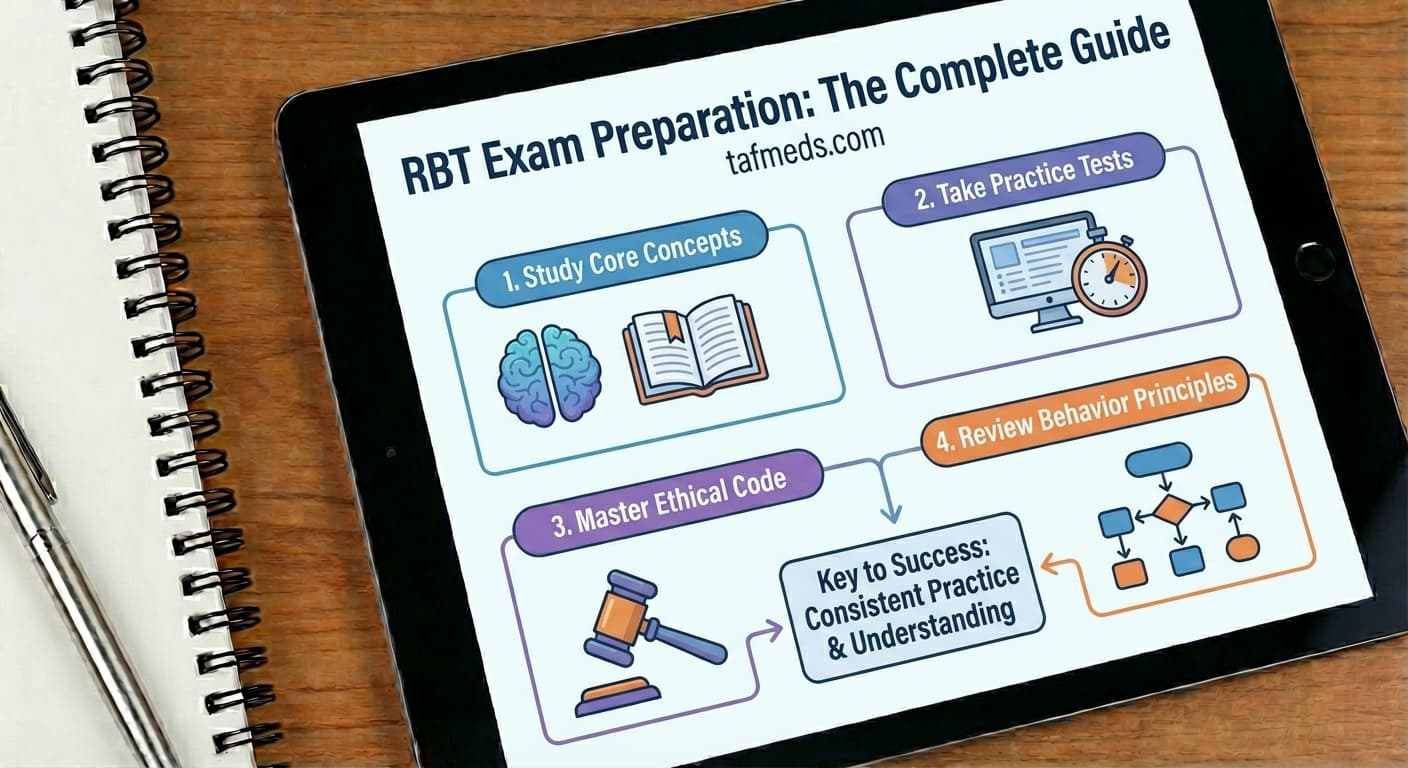
The Registered Behavior Technician (RBT) certification exam can feel overwhelming, but with the right preparation strategy, you can approach test day with confidence. Mock exams are your secret weapon—and this guide will show you exactly how to use them.
Whether you're a few weeks or a few months from your exam date, these evidence-based strategies will help you make the most of every practice test.
Understanding the RBT Exam
Before diving into strategies, let's make sure you understand what you're preparing for:
| Component | Details |
|---|---|
| Total Questions | 85 (75 scored, 10 pilot) |
| Time Limit | 90 minutes |
| Format | Multiple choice |
| Passing Score | Criterion-referenced |
| Task Areas | 6 from the RBT Task List |
Task Area Distribution (3rd Edition, Effective 2026)
| Task Area | Percentage |
|---|---|
| A. Data Collection and Graphing | 17% |
| B. Behavior Assessment | 11% |
| C. Behavior Acquisition | 25% |
| D. Behavior Reduction | 19% |
| E. Documentation and Reporting | 13% |
| F. Ethics | 15% |
The 5-Step Mock Exam Strategy
Step 1: Start with a Baseline Exam
Take your first mock exam before you start intensive studying. This might feel uncomfortable, but it's essential.
Why this matters:
- Identifies your true starting point
- Reveals which task areas need the most work
- Prevents wasting time on areas you already know
- Gives you a benchmark to measure progress
How to do it:
- Find a quiet space with no distractions
- Set a 90-minute timer
- Complete all 85 questions without stopping
- Score yourself honestly
- Record your results by task area
Step 2: Analyze Your Errors
After every mock exam, spend at least as much time analyzing as you did testing.
#### Create an Error Log
For each wrong answer, document:
| Question # | Task Area | Why I Got It Wrong | What I Need to Learn |
|---|---|---|---|
| 12 | Behavior Acquisition | Confused prompting hierarchy | Review prompt fading procedures |
| 27 | Ethics | Didn't know scope of practice | Study RBT ethical guidelines |
#### Common Error Patterns to Watch For
Content errors - You don't know the material
- *Solution*: Review the specific task list items
Application errors - You know concepts but can't apply them
- *Solution*: Practice with more scenario-based questions
Reading errors - You misread or rushed through questions
- *Solution*: Slow down and underline key words
Anxiety errors - You knew the answer but second-guessed yourself
- *Solution*: Practice trusting your first instinct
Step 3: Focus Your Study Time
Based on your error analysis, prioritize your study time strategically.
#### The 70/20/10 Rule
- 70% of study time on your weakest task areas
- 20% maintaining knowledge in average areas
- 10% reviewing strong areas to stay sharp
#### Task Area Study Tips
Data Collection and Graphing (A)
- Know the difference between continuous and discontinuous measurement
- Practice calculating rate, percentage, and mean duration
- Understand how to identify trends in graphed data
- Know the risks of unreliable data collection
Behavior Assessment (B)
- Review preference assessment procedures (multiple stimulus, paired, free operant)
- Study skill assessment methods (curriculum-based, developmental)
- Understand functional assessment components
Behavior Acquisition (C)
- Master prompting and fading procedures (errorless, least-to-most, time delay)
- Understand chaining procedures (forward, backward, total task)
- Know reinforcement procedures and conditioned reinforcers
- Distinguish between maintenance and acquisition
Behavior Reduction (D)
- Focus on antecedent interventions (NCR, high-p, demand fading)
- Understand differential reinforcement procedures (DRA, DRI, DRO, DRL, FCT)
- Know extinction and its secondary effects
- Understand crisis/emergency procedures
Documentation and Reporting (E)
- Practice communicating with supervisors appropriately
- Know how to document variables affecting client progress
- Understand objective session documentation requirements
Ethics (F)
- Study core ethical principles (benefit others, compassion, dignity, integrity)
- Know competence and supervision requirements
- Understand confidentiality and public statement guidelines
- Learn about multiple relationships and cultural humility
Step 4: Practice Under Real Conditions
#### Simulate the Real Exam
- Time it - Set a strict 90-minute timer
- No breaks - Complete the exam in one sitting
- No resources - Don't look up answers
- Quiet space - Minimize distractions
- Same time of day - If possible, match your actual test time
#### Build Your Test-Day Routine
Start practicing your test-day routine during mock exams:
- What will you eat beforehand?
- What time will you arrive?
- What relaxation techniques will you use?
- How will you handle anxiety?
Step 5: Track Your Progress
Monitoring improvement keeps you motivated and identifies persistent problem areas.
#### Weekly Progress Chart
Track your mock exam scores over time:
```
Week 1: 62%
Week 2: 68%
Week 3: 71%
Week 4: 75%
Week 5: 79%
Week 6: 83%
```
Success Indicator
#### Domain-Level Tracking
Create a chart showing your performance in each task area:
| Task Area | Week 1 | Week 2 | Week 3 | Week 4 |
|---|---|---|---|---|
| A. Data Collection and Graphing | 60% | 70% | 75% | 82% |
| B. Behavior Assessment | 55% | 62% | 70% | 78% |
| C. Behavior Acquisition | 65% | 72% | 78% | 85% |
| D. Behavior Reduction | 58% | 65% | 72% | 80% |
| E. Documentation and Reporting | 70% | 75% | 80% | 85% |
| F. Ethics | 62% | 68% | 75% | 82% |
Managing Test Anxiety
Even well-prepared candidates can struggle with anxiety. Here's how to manage it:
Before the Exam
Physical preparation:
- Get 7-8 hours of sleep the night before
- Eat a balanced breakfast
- Avoid excessive caffeine
- Exercise lightly the morning of
Mental preparation:
- Review your progress chart
- Remind yourself of successful mock exams
- Practice deep breathing exercises
- Visualize yourself succeeding
During the Exam
If anxiety strikes:
- Pause and take 3 deep breaths
- Focus on the current question only
- Remind yourself: "I've practiced this"
- Use the flag feature and move on if stuck
Common RBT Exam Mistakes
Avoid these pitfalls that trip up many candidates:
Mistake 1: Memorizing Questions Instead of Concepts
Mock exam questions test concepts, not specific wording. If you memorize questions, you won't be able to answer novel scenarios on the real exam.
Instead: Focus on understanding *why* each answer is correct.
Mistake 2: Cramming the Night Before
Research consistently shows that sleep is essential for memory consolidation.
Instead: Do light review only. Trust your preparation.
Mistake 3: Changing Too Many Answers
Studies show that first instincts are usually correct. Only change an answer if you have a clear reason.
Instead: Use the flag feature to mark uncertain questions, but trust your initial response.
Mistake 4: Rushing Through Easy Questions
Easy questions are "free points." Don't give them away by rushing.
Instead: Read every question carefully, even if it seems simple.
Mistake 5: Not Using the Full Time
If you finish early, use the remaining time to review.
Instead: Check flagged questions and look for careless errors.
The Week Before Your Exam
7 Days Out
- Take your final full mock exam
- Identify any remaining weak areas
- Start reducing study intensity
5 Days Out
- Light review of weak areas only
- Focus on self-care and sleep
- No new material
3 Days Out
- Quick review of key terminology
- Practice relaxation techniques
- Prepare test day logistics
1 Day Before
- Minimal studying (30 minutes max)
- Prepare everything you need
- Get to bed early
- Visualize success
Test Day
- Follow your practiced routine
- Arrive 30 minutes early
- Stay calm and confident
- Trust your preparation
Using TAFMEDS for RBT Exam Prep
Our mock exam system is designed specifically for RBT candidates:
Key Features
- 85-Question Full Exams - Match the real exam format
- Task Area Analytics - Track performance across all 6 areas
- Realistic Scenarios - Practice with diverse clients and settings
- 90-Minute Timer - Build your pacing skills
- Detailed Rationales - Learn from every question
Recommended Study Plan
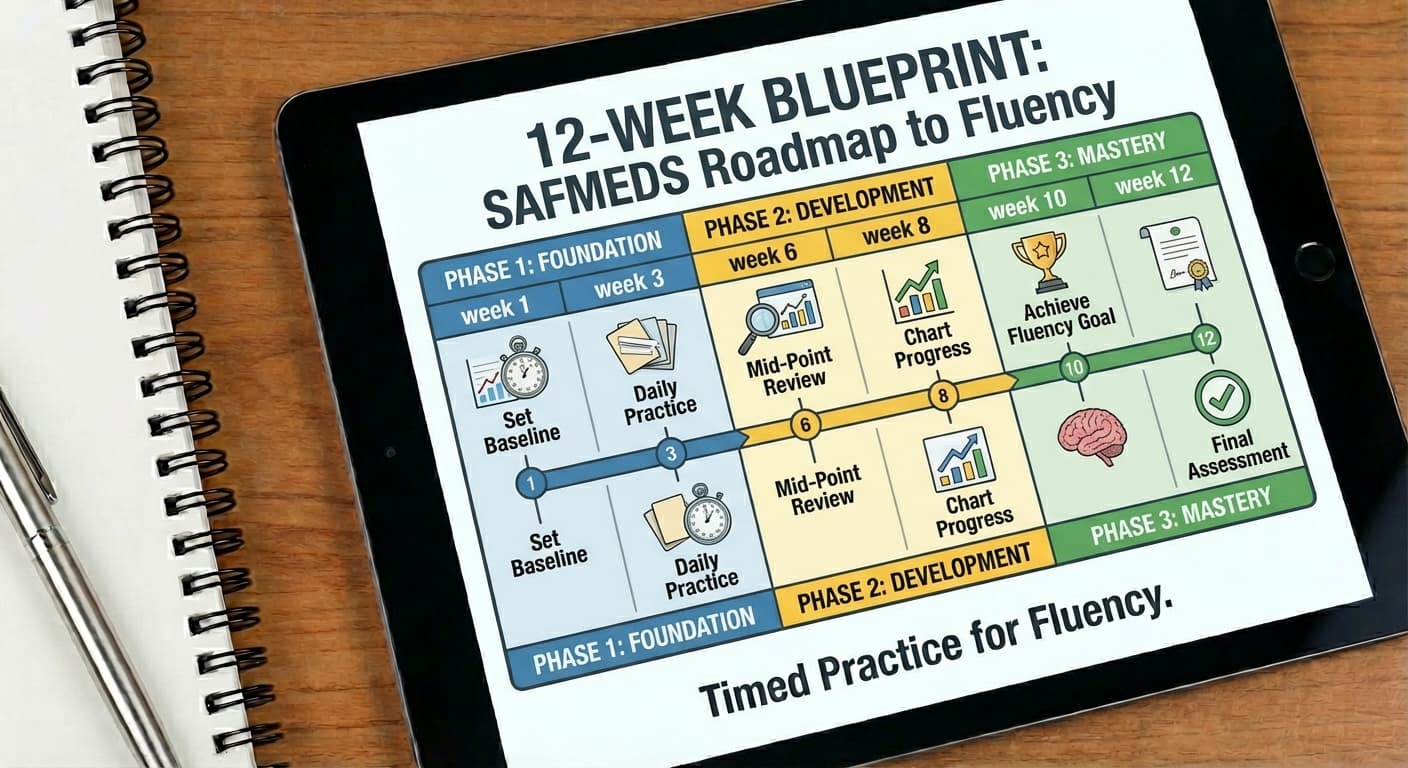
Weeks 1-2: Baseline and Learning
- Take diagnostic mock exam
- Study weak areas intensively
- Review RBT Task List
Weeks 3-4: Practice and Application
- Take 2-3 mock exams
- Focus on scenario-based questions
- Track progress by task area
Week 5: Integration and Confidence
- One final mock exam
- Light review only
- Focus on rest and confidence
Frequently Asked Questions
How many mock exams should I take?
Quality matters more than quantity. 5-8 well-analyzed mock exams are typically sufficient. Taking too many can lead to burnout and question memorization.
What score should I aim for?
Aim for consistently scoring 80% or higher on mock exams before taking the real exam. This provides a comfortable margin above the passing threshold.
What if I keep failing mock exams?
Don't panic. Analyze your errors, adjust your study approach, and consider:
- Extending your study timeline
- Getting additional supervision support
- Focusing on your weakest task area exclusively
How similar are mock exams to the real thing?
Good mock exams mirror the real exam's format, difficulty, and content distribution. However, no mock exam uses actual BACB questions, so focus on learning concepts rather than memorizing specific questions.
Your Action Plan
Ready to start? Here's what to do this week:
- [ ] Schedule your first mock exam for this weekend
- [ ] Set up a quiet, distraction-free testing space
- [ ] Download the RBT Task List as a reference
- [ ] Create an error log template
- [ ] Plan your study schedule for the next 4-6 weeks
Conclusion
Passing the RBT exam on your first try is absolutely achievable with strategic preparation. Mock exams are your most powerful tool—but only if you use them thoughtfully.
Remember: Every mock exam is a learning opportunity. Analyze your errors, track your progress, and trust the process.
Ready to start practicing? Try our RBT Mock Exam with questions aligned to the RBT 3rd Edition Task List (effective 2026).
Looking for more RBT exam resources? Check out our RBT Reference Card for a quick-reference guide to key terminology.