One practice result rises, the next falls, and the week ends somewhere in between. Should you change the deck, practice longer, or keep going?
Start by checking what the results represent. Your first week can help you find a recurring error and plan the next visit. It gives you much less evidence about a lasting trend, the cause of a change, or readiness for an exam. Before finals preparation becomes more demanding, make this short review part of your routine.
Start with saved sessions and comparable conditions
Open Session History and confirm the visits you intend to compare were saved. Then check that they used the same deck, practice direction, response method, and timing duration. Note interruptions, edits to the deck, or scoring corrections.
Raw counts from a 30-second timing and a 60-second timing are not directly equivalent. Untimed work also needs its own comparison. A missing record is missing information, not a zero, and a saved session can still be ineligible for chart credit. Read the explanation shown with the result.
If the conditions changed, keep the record and label the change. You can still learn from the session without treating it as a clean comparison with yesterday.
Find the basic view available on Free
After signing in, open Progress. Free accounts have basic progress tracking. Look for Total sessions, Overall accuracy, Avg correct/min, and Practice minutes, then use Recent Fluency Signal and History to inspect individual visits.
Some summaries combine your saved sessions across decks and dates. They do not automatically describe one specific deck's last seven days. Check the individual records before deciding that a summary reflects the topic you are reviewing.
Review your practice progress: Open Progress, choose the sessions relevant to your question, and note one thing you want to understand.
Read a simulated first week
Suppose a learner completed five 60-second timings on the same deck, typing terms from definitions. The following records are invented for this explanation; they are not customer results or a recommended performance target.
| Date in 2026 | Correct | Incorrect | Skipped | Simulated review note |
|---|---|---|---|---|
| October 26 | 8 | 3 | 1 | Two related terms were confused |
| October 27 | 10 | 2 | 1 | The same distinction needed review |
| October 29 | 9 | 4 | 0 | Both terms appeared among the errors |
| October 30 | 11 | 2 | 1 | One of the terms was still missed |
| November 1 | 10 | 2 | 1 | The distinction still needed explanation |
Each timing lasted exactly one minute, so the counts also equal responses per minute for this example. October 28 and 31 have no observations. Skipped cards are listed separately from incorrect responses.
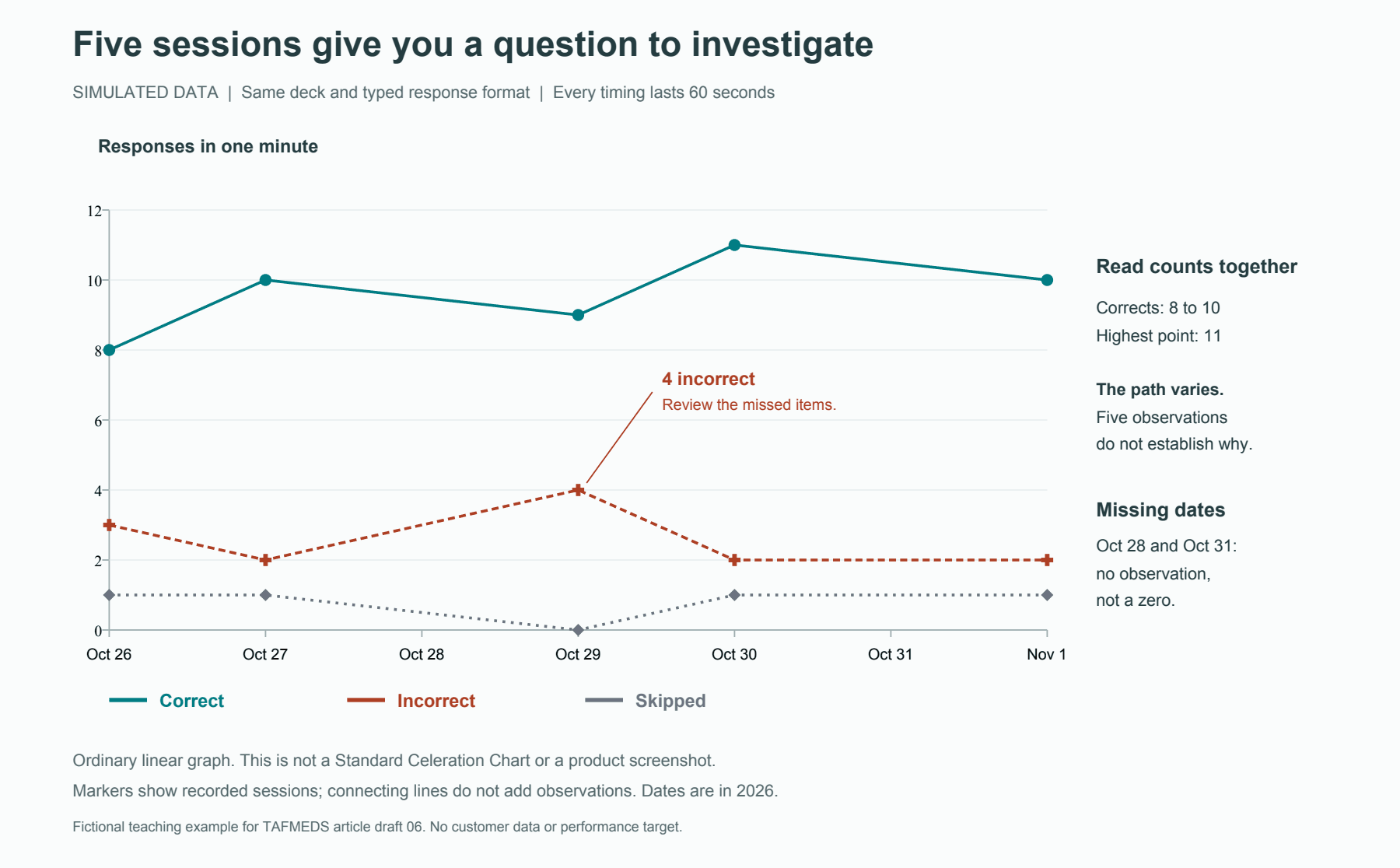
Simulated data on an ordinary linear graph, not a TAFMEDS screenshot or Standard Celeration Chart. Markers show observed sessions; connecting lines do not add observations on missing days.
Read corrects and errors together
The final correct count is higher than the first: 10 rather than 8. But the highest count was 11 on October 30, and the series moves both up and down. Describe that pattern before explaining it.
October 29 is worth reviewing because incorrect responses rose to four. The record alone does not tell you why. The simulated notes give a more useful lead: the same conceptual distinction keeps appearing among the errors.
The skipped column adds context too. Zero skips on October 29 does not prove stronger understanding when incorrect responses increased. Look at what was answered, missed, and left unanswered instead of selecting the most encouraging number.
Change one thing the evidence supports
For this learner, a reasonable next step is to review the two confused terms with the course source and explain a fresh example of each before another timing. Keep the deck and timing settings consistent for that next comparison.
Write the decision in three parts:
- Observation: “The same distinction appeared in several error reviews.”
- Adjustment: “Before the next visit, I will compare the definitions and explain one new example of each.”
- Next check: “After another comparable session, I will inspect those responses again.”
This does not prove that the adjustment caused any later improvement. It makes your study decision explicit and gives you a useful question for the next review. If an answer remains unclear, seek clarification rather than repeat an uncertain definition.
Paid chart example using the same records
Student and Professional include the full Standard Celeration Chart. That is a paid feature; Free's basic Progress view is enough to carry out the review above. Check the current plans if full charting is useful to your routine.
In a chart interpretation exercise, the simulated November 1 timing supplies 10 correct responses per minute and 2 incorrect responses per minute. Compare those with the other dated observations, including the earlier 11-correct session. Do not turn the final point into a claim that performance improved at a steady rate.
The SCC uses calendar time horizontally and a logarithmic frequency scale vertically, so equal proportional changes occupy equal vertical distances. Binder's account of behavioral fluency explains this chart design. The linear illustration above uses different spacing and should not be read as an SCC.
A paid chart can organize the records, but five sessions do not establish retention after a break, successful application to new tasks, or exam readiness. An app aim is a practice reference, not a universal threshold for those outcomes.
Use the public calculator as a learning aid
Without signing in, you can explore the celeration calculator. It takes a starting frequency, ending frequency, and elapsed number of weeks. Use matching units and the actual elapsed interval; October 26 to November 1 is six days, not seven.
Its endpoint calculation leaves out the intervening observations. Use it to explore proportional change, not to diagnose the cause of an error spike or decide that a deck is mastered. Your session notes remain part of the review.
Put the next observation on the calendar
Finish with one sentence: “At my next visit, I will keep ___ the same, review ___, and look for ___.” Choose a time you can realistically return.
Review your Progress, then open Practice when you are ready for the next session. A useful first-week review ends with a specific study action and a plan to check what happens next.